Customers
  Distributor
  Join us as an Advisor
  Employee













































 :
:  :
:  :
: 


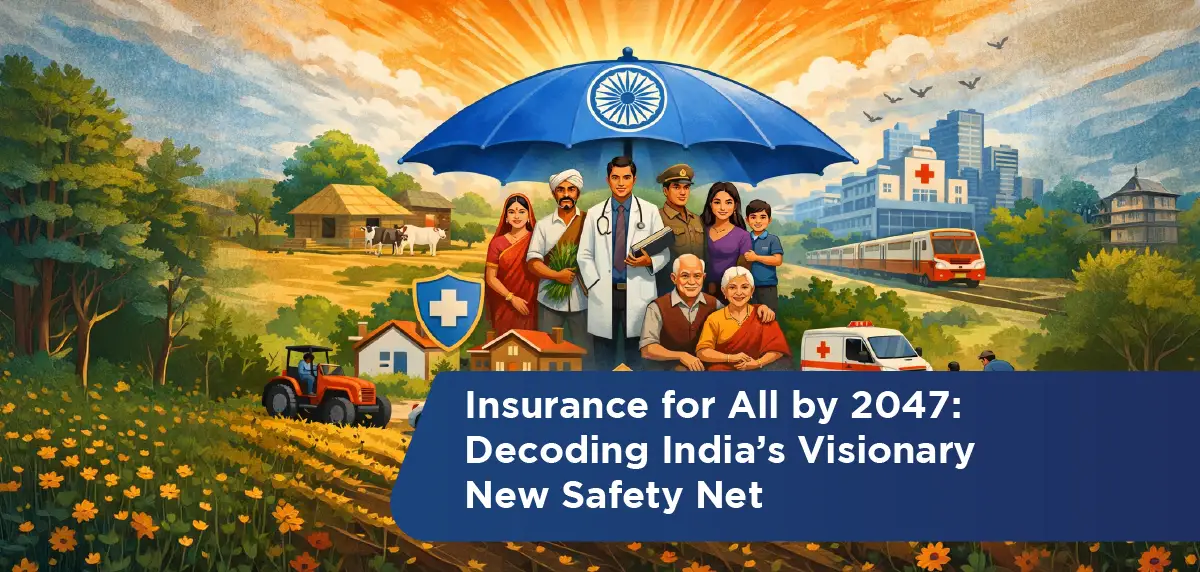





The year 2047 is not just a date on the calendar; it is a destination.
As India marches toward its centenary of independence, the conversation could be said to be shifting from "developing" to "developed." The vision of Viksit Bharat (Developed India) is built on infrastructure, technology, and economic might. But there is a silent, often overlooked pillar that can be said to hold this entire vision together: financial immunity.
For decades, insurance in India was viewed as a tax-saving instrument, a frantic purchase made in February to satisfy Section 80C. But the Insurance Bill 2025 can be said to have brought a historic shift. It can be said to come with the potential to move the narrative from "saving tax" to "saving lives."
The government has set an audacious goal: "Insurance for All by 2047."
But what does this mean for you, your family, and the average Indian household? Let’s decode the vision that aims to turn India’s safety net from a patchwork of policies into a fortress of security.
The "Insurance for All" Ambition
Imagine a cricket team where only one player has a helmet, while the rest face bouncers unprotected. For a long time, this imagined scenario has been the reality of the Indian economy.
Despite being the fourth-largest economy in the world (1), India’s insurance penetration has hovered around 4%. This means that a vast majority of our population, our entrepreneurs, our gig workers, our farmers, and even our salaried middle class, is living one emergency away from financial distress.
The "Insurance for All" mission is not just a slogan; it is an economic necessity. The goal is to ensure that by 2047, every Indian citizen has access to life, health, and property insurance.
Why the sudden urgency?
The logic is simple: A nation cannot be wealthy if its people are financially fragile. When a family loses its primary breadwinner without a safety net, they don't just lose a loved one; they often lose their economic standing, sliding back into poverty. This "economic backsliding" is what the new reforms hopefully aim to stop.
The 2025 Bill can be said to be the blueprint for this transformation. By allowing more players into the market, reducing entry barriers for insurers, and encouraging diverse capital flow, the government is looking to build an ecosystem where insurance is as basic as a bank account or a UPI ID.
Why the Government Worries (And You Should Too)
Policymakers often talk about the "Mortality Protection Gap." It sounds technical, but it is deeply personal.
The Protection Gap is the difference between the money your family would need to maintain their lifestyle if you weren't around, and the actual money available (savings + insurance coverage).
In India, this gap is estimated to be in the trillions of dollars.
The "It Won't Happen to Me" Syndrome
Most of us underestimate this gap. We look at our savings account or a small traditional insurance policy and think, "I’m covered." But inflation is a silent thief. The cost of education, healthcare, and daily living in 2035 or 2040 will be vastly different from today.
The government is worried because a high protection gap puts pressure on social infrastructure. But you should be worried because it puts pressure on your family’s future.
The vision is clear: In a developed India, no child should drop out of college because a parent passed away. No home loan should go unpaid because of an unexpected tragedy.
Beyond the Metros and into Tier 2 and Tier 3 Cities
The "Insurance for All" vision recognizes that the next wave of growth comes from Tier 2 and Tier 3 cities. The new bill lowers the entry capital required for new insurance companies. This is similar to what happened in the telecom sector decades ago. More players mean more competition, and competition inevitably drives prices down.
Term Insurance: Rethinking Civic Duty of Protection:
When we talk about nation-building, we often think of paying taxes, voting, or following laws. But there is a more intimate form of nation-building: protecting your own unit.
A financially secure family is the building block of a secure society. This is where Term Insurance transforms from a financial product into a civic duty.
Term insurance is the purest form of financial love. It doesn't offer investment returns or cashbacks; it offers something more valuable certainty.
In the context of the 2047 vision, buying a term plan is your personal contribution to closing the protection gap. It is a declaration that your family will never be a liability to society and, that your children’s dreams are insulated from the shocks of fate.
The new era of insurance makes this easier than ever:
- Simplicity: Pure protection without hidden clauses.
- High Leverage: A small premium today secures a massive corpus for tomorrow.
- Flexibility: Options to add riders for critical illness or accidental disability, ensuring the net is tight and secure.
At IndiaFirst Life, we believe that "Insurance for All" starts with "Insurance for You." It starts with that one decision to value your human life potential correctly.
The Road Ahead: A Shared Responsibility
The Insurance Bill 2025 has laid the regulatory highway. The government is doing its part by inviting capital, fostering competition, and ensuring strict supervision to protect policyholders.
But the final mile of this journey must be walked by us, the citizens.
We must change our mindset. We need to stop viewing insurance as a "grudge purchase" or a tax receipt. We need to see it as the invisible infrastructure of our lives. Just as we wouldn't build a house without a foundation, we shouldn't build a life without insurance.
The vision of a developed India is not just about bullet trains and smart cities. It is about a nation where every widow is secure, every orphan is provided for, and every elderly person is dignified.
That should be the real picture of 2047.
And it begins with a simple question: Is your safety net ready?
Ready to Close Your Protection Gap?
The vision of 2047 starts at home. Explore how a simple Term Plan can secure your family’s future today. Check Your Protection Score
Explore IndiaFirst Life Term Plans
Disclaimer:
The information provided in this article is for educational purposes and is based on the current understanding of the Insurance Bill 2025 and industry trends. Readers are advised to consult with financial advisors for personal planning.
(1) Source: The Hindu