Customers
  Distributor
  Join us as an Advisor
  Employee













































 :
:  :
:  :
: 


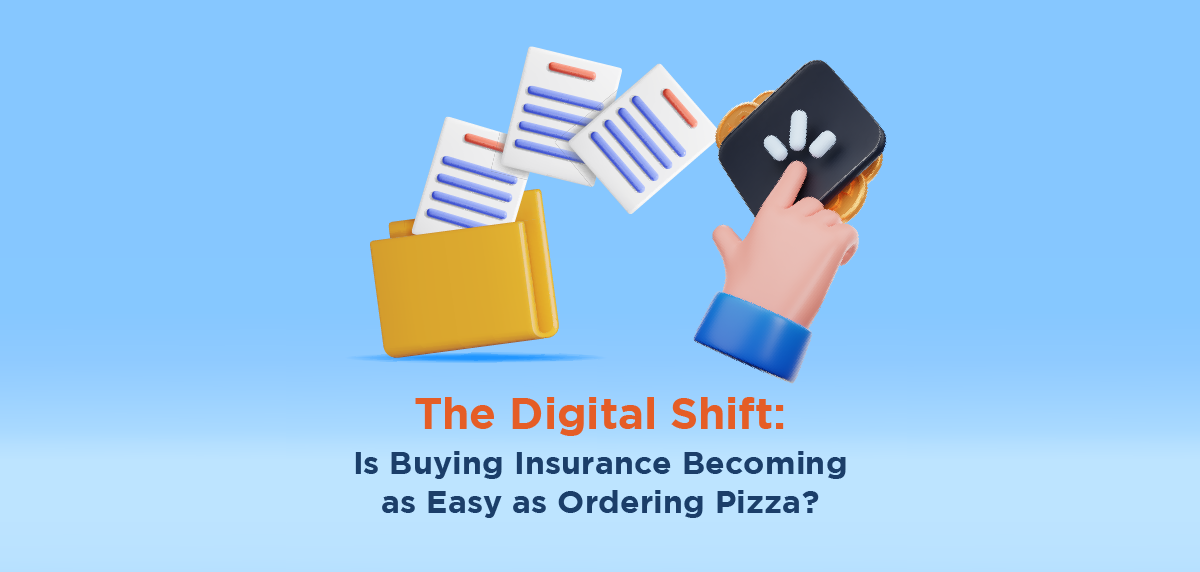







It is Friday night. You open an app, scroll for two minutes, tap a button, and within 30 minutes, a hot pizza arrives at your doorstep. No paperwork, no questions asked, no medical tests to prove you are hungry.
For years, we have lived in this world of "instant gratification", for food, for taxis, for movies, and for more. But the moment we thought about buying Life Insurance, we stepped into a time machine that took us back to the 1990s.
The mental image of buying insurance has always been daunting: stacks of forms, xerox copies of your Aadhaar card, physical medical check-ups, and a nervous wait of 2-3 weeks to see if you were "approved."
But the Insurance Bill 2025 is pushing the accelerator on a massive digital transformation. The industry is racing toward a future where protecting your family could be as seamless (and almost as fast) as ordering that Friday night dinner.
Let’s decode the "Digital Shift" and what it means for the modern, tech-savvy policyholder.
1. From "Micro-Regulation" to "Macro-Tech"
Why was insurance so slow in the past? It wasn't because insurers were lazy; it was because the rules were rigid.
Previously, regulations required physical wet signatures, hard copies of documents, and manual verifications for almost everything. It was a "better safe than sorry" approach, but it led to large turnaround times.
The 2025 Bill encourages a shift away from "Micro-Regulation." Instead of dictating how a company must verify a customer (e.g., "collect a physical bill"), the regulator may now set the outcome (e.g., "ensure the customer is who they say they are").
Enter AI and Account Aggregators
This regulatory freedom should encourage insurers to use cutting-edge tech:
- Video KYC: No more waiting for an agent to visit your house. Your face is verified instantly via your phone camera.
- Account Aggregators: Instead of uploading 6 months of bank statements, you simply give secure consent for the insurer to "ping" your bank. The data is transferred instantly, encrypted, and verified in seconds.
- AI Underwriting: Smart algorithms can analyse your financial health and risk profile in milliseconds, replacing the human underwriter for standard policies.
The result? The "processing time" shrinks from weeks to minutes.
2. The Rise of "One-Click Issuance"
We could say that we are moving toward the holy grail of InsurTech: One-Click Issuance.
Imagine this: You are already a customer of a bank (like our partners, Bank of Baroda or Union Bank). The bank knows your income, your address, and your spending habits. When you log in to your insurance portal, the system already "knows" you.
- Pre-Approved Covers: You see a personalized quote: "Based on your profile, you are eligible for ₹1 Crore cover."
- Zero Documentation: Since your data is already verified, you don't upload a single file.
- Instant Policy Generation: You pay the premium, and ping! The policy document lands in your email inbox immediately.
While this is already happening for smaller covers, the 2025 reforms could help make this the standard for larger Term Plans and Savings Plans too. The friction of "applying" should be replaced by the ease of "activating."
3. Integrating the latest tech (The Phygital Balance)
With all this talk of AI and speed, a valid fear arises: Will I ever talk to a human again?
Buying insurance is easy; claiming insurance is emotional. When a family is grieving, they don't want to chat with a bot named "Alex." They want empathy, reassurance, and a human voice.
This is where the concept of "Phygital" (Physical + Digital) becomes crucial.
- Bots for Buying: Let the AI handle the boring stuff like forms, payments, and address changes. It’s faster and error-free.
- Humans for Helping: Because AI handles the paperwork, the human experts, such as the ones at IndiaFirst Life, are free to handle the complex stuff such as claims, financial planning, and emotional support.
The physical branch should simply evolve into a "Solution Centre" from a "Form-Filling Centre."
4. The IndiaFirst Life Digital Edge
At IndiaFirst Life, we have been preparing for this shift long before the bill was drafted. We understand that our customers (including, millennials, Gen Z, and tech-savvy parents), value time as much as money.
Our IndiaFirst Life Elite Term Plan is a prime example of this digital-first philosophy.
The "DIY" Protection Journey
- Buy Online, Save More: We pass the savings of digital efficiency back to you. When you buy online, you often get a discount on the first year's premium because we don't have to process physical paper.
- Transparency Dashboard: You can track your application status in real-time, just like tracking a package. No more calling customer care to ask, "Kya status hai?" (What's the status?).
- E-Insurance Account (eIA): Your policy is stored digitally. It can never be torn, lost in a fire, or eaten by termites. It lives securely in the cloud, accessible 24/7.
We have built a platform where the technology is invisible—it just works—so you can focus on the visible benefit: Safety for your family.
Conclusion: Speed with Safety
Is buying insurance becoming as easy as ordering pizza? Almost. Adoption of the suggestions and possibilities mentioned above could strengthen the transformation.
The digital shift is not just about "convenience." It is about accessibility. It is about ensuring that a busy father in Mumbai or a working mother in a remote town in Assam can both secure their families' futures in 15 minutes, without leaving their homes.
The Insurance Bill 2025 has cleared the runway. The technology is ready for take-off. The only question left is: Are you ready to click the button?
Fast-Track Your Family’s Security
Experience the speed of digital protection. Get a quote in seconds and secure a ₹1 Crore cover from the comfort of your couch.
Calculate Premium in 30 Seconds
View IndiaFirst Life Elite Term Plan
Disclaimer:
The information provided in this article is for educational purposes and is based on the current understanding of the Insurance Bill 2025 and industry trends. Online discounts and digital issuance are subject to underwriting guidelines and policy terms.