Customers
  Distributor
  Join us as an Advisor
  Employee













































 :
:  :
:  :
: 


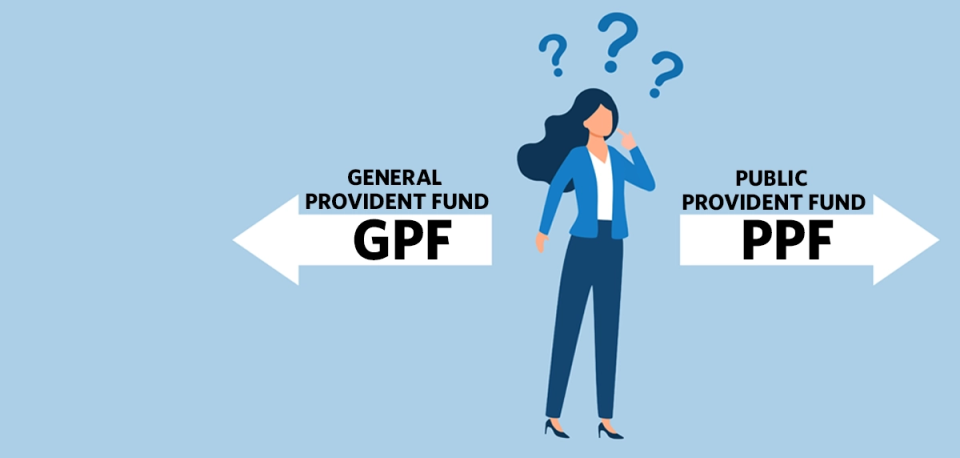







Saving for the future is an important part of financial planning. In India, one of the most popular and widely known savings scheme is the Public Provident Fund (PPF). With a PPF, you can park small amounts at regular intervals to build a corpus which you can enjoy once your account matures. However, not many know that there is another provident fund meant for certain individuals only, known as the General Provident Fund or GPF.
While both are savings schemes meant to encourage savings as a regular habit, there are some key points of difference between GPF and PPF. Let’s explore more in this regard.
But first, let’s learn more about each fund.
What is GPF?
General Provident Fund is a savings scheme available only to government employees in India. It is a type of provident fund where employees contribute a portion of their salary every month to build a substantial corpus over time. The accumulated corpus earns interest (as set and revised by the government) and is paid out at the time of retirement or resignation. Currently, the interest rate for GPF is set at 7.1% per annum.
Understanding what GPF is, will be crucial if you are employed by the central or state government, since this fund can help you create long-term financial stability.
What is PPF?
It is a long-term savings scheme available to all Indian citizens. It was launched by the government to encourage small savings amongst citizens, by offering attractive interest rates and tax benefits. The current PPF interest rate is set at 7.1% per annum.
PPF is open to everyone, from salaried employees and professionals to the self-employed and even unemployed individuals. If you are not a government employee but want similar benefits to GPF, PPF is a strong alternative. You can use a PPF calculator to estimate your returns from your PPF account and ensure better financial planning.
Now that you know what GPF and PPF are, let’s explore how one differs from the other.

Differences between GPF and PPF
Here are some points that help pit GPF vs PPF for a clear comparison:
GPF | PPF | |
Full form | General Provident Fund | Public Provident Fund |
Eligibility | Only for government employees | Open to all Indian citizens |
Interest | Set by the government and revised as per notifications. The current interest rate is 7.1% p.a. | Same as PPF - set by the government. The current rate stands at 71.% |
Lock-in Period | Until retirement or resignation | 15 years, and extendable in blocks of 5 years afterwards |
Withdrawal Facility | Allowed for various reasons on the condition that the employee has completed 10 years of service or is within 10 years from the date of retirement or superannuation, whichever is earlier. | Partial withdrawals allowed after the 5th year. |
Maturity | Matures on the retirement or resignation of the subscriber, after which they receive the full corpus. | Matures on the completion of 15 years of the PPF account, after which the investor can fully withdraw the PPF funds. Can be extended in blocks of 5 years if the individual wishes to. |
Tax Benefits** | Contributions are eligible for tax deductions under Section 80C. The interest earned and the maturity amount are also tax-free. However, if the contribution is more than ₹5 lakhs, the interest earned on it is taxable. | PPF has an E-E-E nature, which means the contributions, interest earned, and maturity amount are all tax-exempt. |
How to Access | By securing a job with the government. | By opening an account through banks and post offices |
Both GPF and PPF are solid saving schemes that come with government backing, stable returns, and tax benefits. When you look at GPF vs a PPF, the main difference lies in accessibility. GPF is a benefit exclusively for government staff, while PPF is open to everyone. Your choice depends on your employment status and financial goals
** Tax exemptions are as per applicable tax laws from time to time.