Customers
  Distributor
  Join us as an Advisor
  Employee













































 :
:  :
:  :
: 


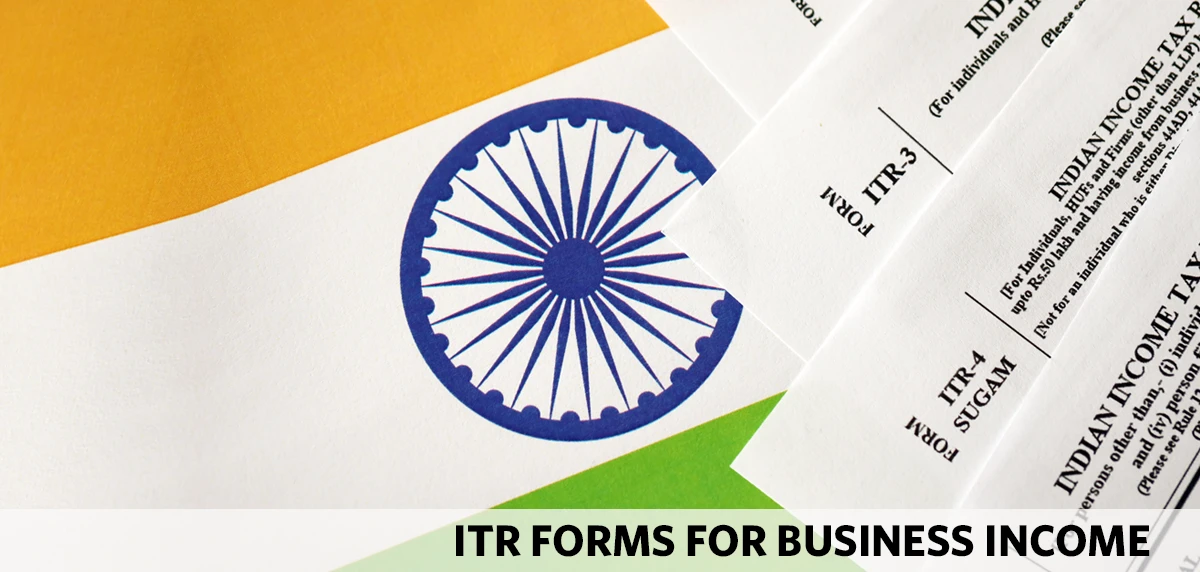




If you run a business (small or medium; on the side or full-fledged), you already know that managing money is only half the job. The other half deals with paperwork, especially when tax season arrives.
It may not be uncommon to get confused about the right Income Tax Return (ITR) form for business income, when to file, what to include, and what happens if they miss the deadline.
Instead of letting the process overwhelm you, read on to understand its different aspects better so that you can efficiently handle taxation in the future.
1. Which ITR form should a business use?
When people search for an ITR form for business income or a business income tax return form, they generally come across terms like ITR-3, ITR-4, and, at times, even ITR-5.
Here is how to zero in on the right one without overthinking:
● ITR-3
- Perfect for individuals or Hindu Undivided Families (HUFs) running a proprietorship.
- Use this if you maintain books of accounts, do not want to follow a presumptive taxation scheme, or if your business is larger with detailed financial records.
● ITR-4 (Sugam)
- Best for small businesses that want to file using the presumptive taxation scheme under Sections 44AD, 44ADA, or 44AE.
- Popular among freelancers, shop owners, consultants, and small traders.
- Lower compliance, quick filing, and fewer details to fill out.
● ITR-5
- Applicable for partnerships, Limited Liability Partnerships (LLPs), and certain other business structures.
Once you figure out your structure, choosing the right form feels much simpler. Most small-sized and mid-sized business owners either file through ITR-3 or ITR-4.
2. What counts as “business income”?
When filing a business ITR, you need some clarity on what the tax department considers as business income.
Here are the major buckets:
- Revenue from sales/services
- Commission or brokerage income
- Professional earnings (for doctors, lawyers, designers, consultants, and other similar professions)
- Income from online businesses, e-commerce, and home-run ventures
- Any profit from activities linked to trade
If you’re earning through these sources, you fall under the business income category and must pick the corresponding ITR form.
What you must keep ready before filing
To avoid running around at the last minute, get hold of the essentials listed below beforehand:
- PAN card, Aadhaar card, and bank details
- Goods & Services Tax (GST) statements (if applicable)
- Profit & Loss (P&L) account and balance sheet
- Details of expenditures like rent, salaries, marketing, raw materials, and utilities.
- Tax Deducted at Source (TDS)/Tax Collection at Source (TCS) certificates
- Loan statements
- Investment proofs
An income tax return filing is all about presenting a clear picture of what you earned and spent. The more organised you are, the smoother it gets for you.
How to file ITR for business income
Filing ITR for business income becomes easier when you follow a flow and don’t jump in blindly.
Step 1: Sign in to the income tax portal
For this, input your PAN-based credentials.
Step 2: Select the correct assessment year
This ensures your income is reported in the correct year.
Step 3: Choose the applicable ITR form
Pick from ITR-3 or ITR-4 (for presumptive income) or any other applicable form.
Step 4: Input basic information
Your name, address, contact information, and filing status.
Step 5: Report your business income
Enter:
- Gross receipts
- Operating expenditure
- Net profit
- Depreciation (if applicable)
- Taxable income
Step 6: Authenticate tax computation
The system auto-computes details, but reviewing can help avoid any errors.
Step 7: Pay remaining taxes
If the advance tax was not fully paid, clear the dues before submitting.
Step 8: e-Verify
This completes the filing; no physical signatures are needed.
What happens if you don’t file the ITR?
Some may ask, “What happens if I don’t file ITR?”
Here’s the simple truth:
- You may face penalties under Section 234F.
- Interest can get added to pending tax dues.
- You may lose out on refunds.
- Loan approvals (such as for home, business, or car) may become difficult.
- Visa processing may be affected.
- You may not be able to carry forward business losses.
Skipping ITR can create more problems than the time it takes to file it. Think of it as securing your financial track record.
Is there a way to file late?
If you miss the deadline, all is not lost.
You are allowed to file an updated return, known as ITR-U. This lets you correct missed income, under-reported income, or even file a return you didn’t file earlier. But keep in mind that additional taxes and penalties apply. It’s a safety net, not a shortcut.
Use ITR-U only, when necessary, not as a habit.
When is the last date of ITR filing for businesses?
The ITR filing last date usually falls on:
- 31st July for individuals and small businesses not requiring an audit
- 31st October for businesses that require an audit
Extension of these dates may be announced by the government. But relying on extensions is risky. The best practice is simple: begin preparing early.