Customers
  Distributor
  Join us as an Advisor
  Employee













































 :
:  :
:  :
: 








For many individuals and businesses, understanding how tax is collected can be confusing. One of the key mechanisms in India is Tax Deducted at Source. This is where tax is collected directly at the point of payment and not at any later time.
Knowing the different types of Tax Deducted at Source (or TDS) is important for both payers (deductors) and recipients (deductees). From salaries and interest to professional fees and rentals, TDS is applicable in many situations. A clear grasp of how it works, including having an idea of the TDS rate chart, can help you stay compliant and avoid penalties.
What is Tax Deducted at Source?
It is a system where tax is deducted by the payer before making a payment to the recipient. The deducted amount is then deposited with the government. This method ensures early collection of tax and widens the tax net.
TDS applies to various kinds of payments: salaries, rent, professional fees, interest income, and more. For individuals, TDS appears as a credit in Form 26AS, which can then be adjusted against their final tax liability.
The system operates with the help of a TDS rate chart, which lists the percentage of tax to be deducted for various transactions.
Types of TDS
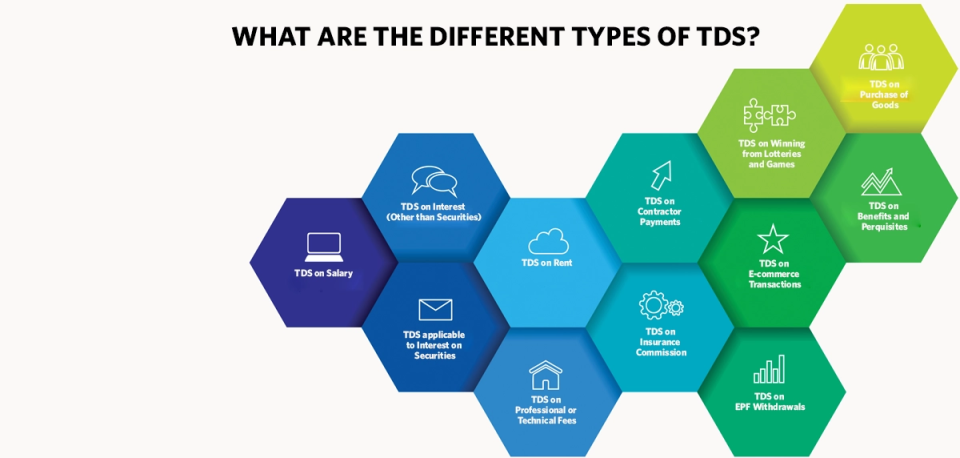
There are multiple types of TDS, each designed for a specific category of payment. While the list is extensive, we will look at some commonly used categories for both individuals and businesses.
1. TDS on Salary
Under Section 192, employers deduct TDS on salary. This is carried out on the basis of the employee’s estimated annual income and tax slab. There is no fixed rate; instead, the employer calculates tax liability after factoring in deductions and exemptions.
2. TDS on Interest (Other than Securities)
Under Section 194A, TDS applies to interest paid on loans and recurring deposits. This section also deals with TDS on fixed deposits. When the interest earned crosses the exemption limit (₹40,000 for individuals and ₹50,000 for senior citizens), banks deduct TDS on the interest before crediting the amount. If you have a fixed deposit, the interest on the same will be subject to TDS on fixed deposits when the interest exceeds the prescribed limits.
3. TDS applicable to Interest on Securities
Section 193 discusses TDS applicable to interest on securities such as debentures. In case PAN is not available, the TDS rate can be 20% (and 10% in case of PAN availability).
4. TDS on Rent
Sections 194I and 194IB include clause on TDS on rent if it exceeds the prescribed threshold. This includes rent for land, buildings, machinery, and furniture.
5. TDS on Professional or Technical Fees
Section 194J covers TDS on professional or technical fees. This can include payments made to professionals, such as consultants, doctors, engineers, or technical service providers. The rates differ according to the nature of the service.
6. TDS on Contractor Payments
Section 194C requires TDS on payments to contractors. This applies to all contractors, whether individuals or companies, in fields such as transport, construction, and labour supply.
7. TDS on Insurance Commission
Sections 194D and 194DA cover TDS on insurance commissions and payouts. TDS applies when payouts exceed the prescribed threshold (₹15,000 in a financial year) to the commissions that agents or intermediaries earn from selling insurance policies.
8. TDS on Winning from Lotteries and Games
Section 194B discusses TDS on winnings from lotteries, game shows, and other competition winnings. The TDS rate stands at a flat 30%, provided the amount exceeds ₹10,000 in a financial year.
9. TDS on E-commerce Transactions
Section 194O mandates platforms deduct TDS on e-commerce transactions at 1% on the sale of goods or services made by sellers. The Tax Deducted at Source exemption limit stands at ₹5 lakh in a financial year.
10. TDS on EPF Withdrawals
According to Section 192A, a 10% TDS shall apply on premature withdrawals from the Employees' Provident Fund (EPF). This TDS on EPF withdrawals applies only if the withdrawal is made before completing five years of continuous service and when the amount exceeds ₹50,000.
11. TDS on Purchase of Goods
Section 194Q requires a buyer to deduct TDS at 0.1% on payments made to a resident seller for goods. This applies once the buyer's total purchases from that specific seller exceed ₹50 lakh in a financial year. The TDS on the purchase of goods is deducted from the entire amount paid after the threshold is crossed.
12. TDS on Benefits and Perquisites
Section 194R mandates a 10% TDS on benefits or perquisites (like free tickets, samples, or vouchers) provided to a resident arising from a business or professional relationship. The provision applies when the total value of such benefits given to a single recipient exceeds ₹20,000 in a financial year.
13. TDS on Sale of Immovable Property
As per Section 194IA, the buyer of a property must deduct TDS at 1% of the total sale value. This applies to the transfer of any immovable property (other than agricultural land) where the sale consideration exceeds ₹50 lakh.
These categories represent some of the most frequently used types of TDS. But there are many more sections under the Income Tax Act that cover different kinds of income.
Businesses and individuals making payments are obligated to deduct the correct TDS, deposit it on time and file TDS returns. Failure to do so can lead to interest, penalties, and disallowance under prevailing tax rules.
Sectional TDS Rate Chart
Below is a list of key types of TDS with the applicable rates drawn from the latest available TDS rate chart. Please note that taxpayers should always check the updated chart for exact thresholds and conditions.
Section | Nature of Payment | TDS Rate |
192 | Salary | As per income tax slabs |
192A | Premature EPF / RPF withdrawal | 10% |
194 | Dividends | 10% |
194A | Interest other than securities (incl. TDS On Fixed Deposits) | 10% (20% in absence of PAN) |
194C | Payments to contractors/sub-contractors | 1% (Individuals/HUF) / 2% (Others) |
194D | Insurance commission | 5% |
194H | Commission or brokerage | 5% |
194I(a) | Rent for plant & machinery | 2% |
194B | Lottery, game show winnings | 30% |
194IA | Purchase of immovable property (residents) | 1% |
194O | Payments by e-commerce operators to participants | 1% |
Why It is Important to Understand TDS
Whether you earn income from salary, rent, interest, or professional work, TDS likely affects you.
Knowing the types of TDS helps in:
- Identifying where deductions apply
- Verifying correct deductions using the TDS rate chart
- Verifying the information in Form 26AS with actual income
- Avoiding penalties due to non-deduction or late payment
- Making the right financial decisions in terms of tax-saving and efficiency, in the entire TDS to self-assessment tax journey.
Understanding the different types of TDS and how Tax Deducted at Source works is essential for smooth tax compliance. By referring to the TDS rate chart, taxpayers can ensure accurate deductions across various payments. Knowing when TDS applies, such as salary, rent, or interest, can help you avoid incorrect tax filings and ensure an overall smooth process.