Customers
  Distributor
  Join us as an Advisor
  Employee













































 :
:  :
:  :
: 


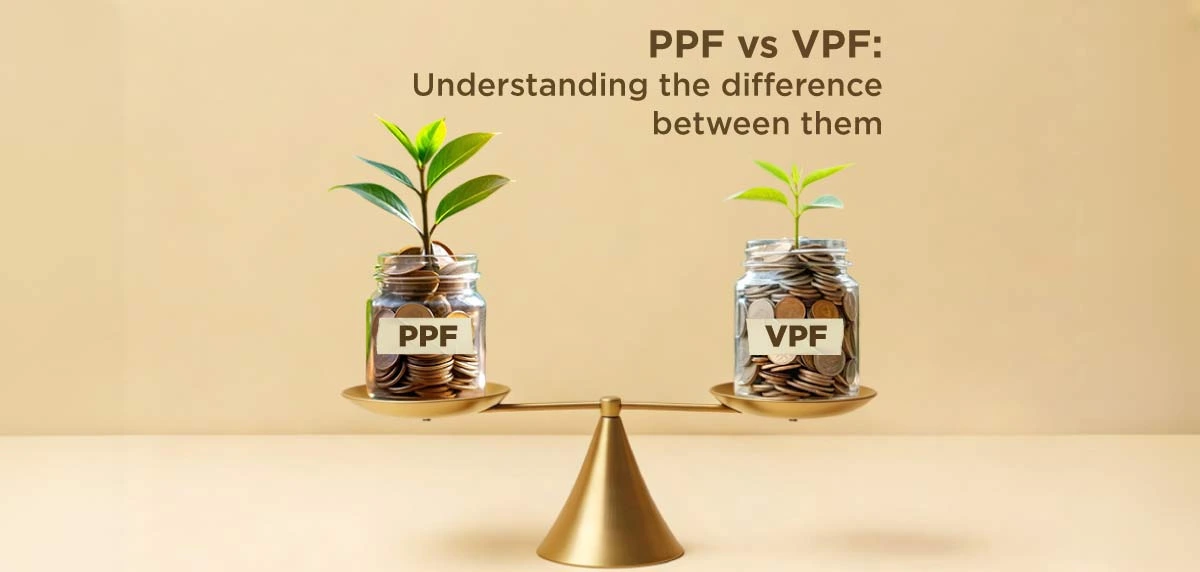







A discussion on PPF and VPF matters in real-life salary discussions and financial planning for the family. The truth is that these two are not competing products in the same lane. One is a government-backed small savings scheme you open yourself. The other is an additional contribution you choose inside your salary-linked provident fund. Once you understand that structural difference, most of the confusion around VPF and PPF differences go away.
What is PPF?
PPF is the Public Provident Fund, a government-backed small savings scheme. You open it at a post office or a bank and contribute at your preferred frequency. The account matures after 15 financial years, and you can extend it in blocks of 5 years.
What is VPF?
VPF stands for the Voluntary Provident Fund. It is not a separate account you “open” in the market. It is an option inside your EPF framework if you are a salaried employee covered by EPF. You simply choose to contribute more than the standard rate from your salary toward the provident fund.
Differences between PPF and VPF
The fastest way to understand the PPF and VPF difference is to compare them on similar aspects.
Factor | PPF | VPF |
Who can use it | Most residents who can open a PPF account | Only EPF-covered salaried employees |
How you contribute | You deposit directly into the account | Extra deduction from salary into EPF |
Annual limit | Up to ₹ 1,50,000 per year | Up to 100% of basic + DA |
Tenure and lock-in | 15 years, extendable in 5-year blocks | Linked to EPF rules and employment timeline |
Interest rate | 7.1% in recent quarters | 8.25% for FY 2025–26 |
Control | High control (you decide deposits) | Salary-linked, changes need to be made via HR/payroll |
Liquidity | Loan and withdrawal rules apply | Withdrawals largely follow PF withdrawal rules |
The differences between VPF and PPF showcases not just interest rates but also the practical aspects of managing these options.
PPF or VPF: Which is better for you?**
The honest answer to the PPF or VPF debate is that there is no clear winner by default. You choose on the basis of your situation.
Choose PPF when these statements seem to align with your goals.
- You want the best long-term, low volatility investment plan not tied to your employer.
- You want a strict annual cap so that you do not overcommit and damage your monthly budget.
- You are building a predictable corpus over 15+ years and do not care about short-term liquidity.
Choose VPF when these statements seem to align with your goals.
- You want to push more money into a provident fund without having to manually deposit each month.
- You have stable salary cashflow and you can lock away a bigger amount without needing it back soon.
- You are comfortable managing your tax limits, so that large PF contributions do not create a tax surprise later.
How to choose between PPF and VPF **
You do not need complicated analyses to decide. You need a few simple checks.
Step 1. Run a basic projection. Use a PPF calculator to see what a fixed annual deposit like ₹ 1,50,000 becomes over 15 years at the current rate environment, so you understand the scale.
Step 2. Compare your “parked” money. If you already have EPF deductions, adding VPF increases your lock-in exposure. If you do not have a solid emergency fund, this can become stressful.
Step 3. Evaluate post-tax reality. A fixed deposit interest is taxable for most people, which reduces compounding speed compared to tax-free growth structures. This matters if you are choosing between PPF and a bank FD for the same money.
Step 4. Use a compound interest calculator only as an alternative tool, not as your decision-maker. It helps you visualise compounding, but the decision still comes down to liquidity and rules.
PPF for minors
One aspect where PPF is uniquely practical is when investing for minors. You can open a PPF account for a minor child through a guardian, and it becomes a structured long-term bucket for education or future needs. The scheme rules around contribution limits and long-term maturity still apply.
VPF cannot play this role because it is tied to your salary EPF account and not a separate account you open for someone else.
If you are planning long-term for your family, PPF gives you the ability to create separate buckets for different goals.
Common mistakes in decision-making**
- You chase interest rate alone and ignore lock-in when considering PPF vs VPF. Rates change, but liquidity rules hurt immediately when you need cash.
- You treat VPF like a “set and forget” option, then realise your monthly budget cannot handle it after EMIs and expenses.
- You compare PPF with a fixed deposit without adjusting for tax impact, which makes FD returns look better than they really are for many taxpayers.
When it comes to understanding the PPF vs VPF debate, remember that
- PPF is a personal, government-backed long-term account with a strict yearly limit of ₹ 1,50,000 and a long maturity structure, with the current PPF rate being 7.1% in recent times.
- VPF is an extra salary-linked PF contribution that earns the same interest as EPF, which is 8.25% for FY 2025–26, and it can be pushed up to 100% of your basic plus DA if your payroll allows it.
The practical answer to the PPF vs VPF debate on which is better is that
- You pick PPF when you want control, predictable limits, and long-term tax-efficient compounding that is not tied to your employer.
- You pick VPF when you want automated discipline, you have stable cash flow, and you can stay under the PF tax thresholds so that your effective return stays untouched.
** Tax exemptions are as per applicable tax laws from time to time.