Customers
  Distributor
  Join us as an Advisor
  Employee













































 :
:  :
:  :
: 


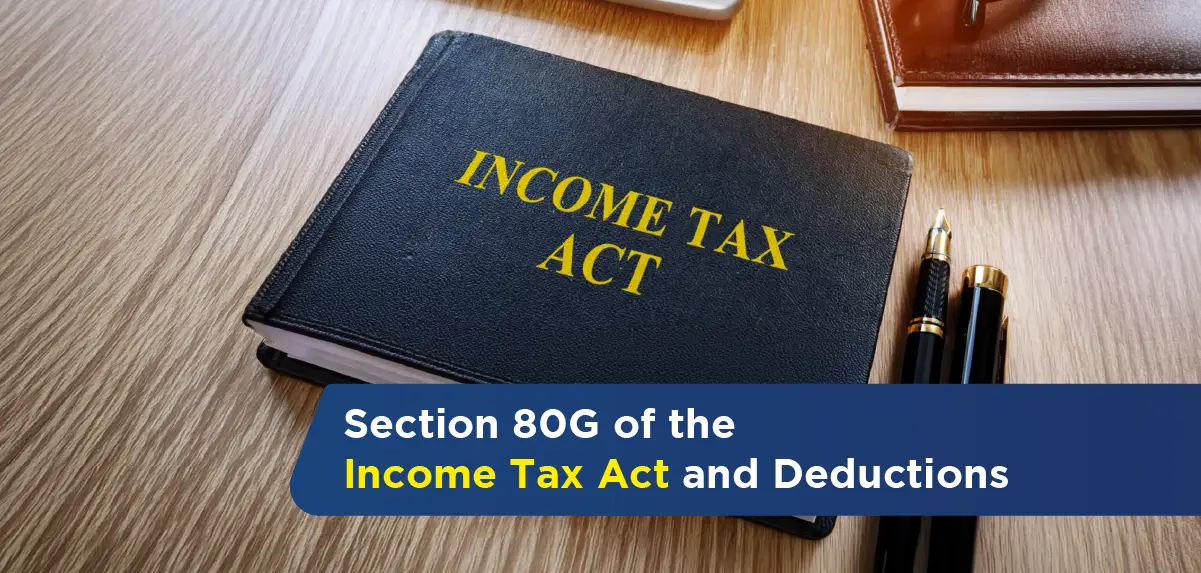




Section 80G of the Income Tax Act allows taxpayers to claim deductions for donations made to eligible charitable institutions and funds. While many people are aware that donations can offer tax benefits, not many people may understand how the deduction works, what limits apply, and how it fits into the overall process of filing returns.**
The information provided below explains section 80G of the Income Tax Act, the 80G deduction limit, how the deduction is claimed while filing returns, and how it differs from other commonly used sections such as Section 80C and Section 80D.**
What Is Section 80G?**
In the simplest of words, Section 80G of the Income Tax Act provides tax deductions for donations made to certain approved charitable organisations, trusts, and relief funds. The intention behind this section is to encourage charitable giving while offering tax relief to taxpayers.
When people refer to sec 80G or 80G of Income Tax Act, they are talking about the same provision. It applies to individuals, Hindu Undivided Families, companies, and other taxpayers, subject to conditions.
Not all donations qualify for deduction. Only donations made to institutions that are mapped for eligibility under section 80G are considered. The deduction is available only if the donation is made in a recognised manner and supported by proper documentation.
What Is an 80G Deduction?**
It is a deduction that allows a taxpayer to reduce taxable income by claiming a portion of the amount donated to eligible organisations. The deduction does not reduce tax directly. Instead, it reduces the income on which tax is calculated.
For example, if a taxpayer donates to an eligible fund and qualifies for an 80G tax deduction limit of 50 percent, only half of the donated amount can be claimed as a deduction. The actual tax benefit depends on the individual’s tax slab.
This distinction is important when understanding how section 80G works in practice.
Types of Deductions Under Section 80G**
Donations eligible under section 80G are broadly divided into four categories:
1. Donations eligible for 100 percent deduction without any qualifying limit
2. Donations eligible for 50 percent deduction without any qualifying limit
3. Donations eligible for 100 percent deduction subject to qualifying limit
4. Donations eligible for 50 percent deduction subject to qualifying limit
The qualifying limit is generally 10 percent of adjusted gross total income. This limit is relevant only for certain categories of donations.
Understanding which category a donation falls under is essential to calculate the correct 80G deduction limit.
What Is the 80G Deduction Limit?**
The 80g deduction limit refers to the maximum amount of donation that can be claimed as a deduction in a financial year.
- For donations subject to qualifying limits, the deduction cannot exceed 10 percent of adjusted gross total income.
- The value of adjusted gross total income is calculated after reducing specific deductions, such as those under Section 80C, Section 80D, and certain other provisions.
It is important to note that donations made in cash above a specified amount are not eligible for deduction. To claim an 80 g income tax deduction, the donation must be made through acceptable modes such as cheque, bank transfer, or digital payment.
Eligible and Ineligible Donations
Only donations made to approved institutions qualify under section 80G. Donations to individuals, political parties, or foreign charities are not eligible unless specifically notified.
Donations made in kind, such as food or clothes, are also not eligible for deduction under 80G of income tax act. Only monetary donations qualify.
Taxpayers should verify the approval status of the institution before making a donation if they intend to claim a deduction.
Documentation Required for Section 80G**
To claim an 80G deduction, proper documentation is essential. The taxpayer must obtain a donation receipt from the charitable organisation.
The receipt should contain:
- Name of the donor
- Amount donated
- Name and address of the organisation
- PAN of the organisation
- 80G registration number
Without a valid receipt, the deduction may be disallowed during processing or scrutiny.
How to Claim Section 80G While Filing Returns**
To claim a deduction under section 80G, the taxpayer must disclose donation details while filing the income tax return.
This involves:
Step 1. Entering the donation amount
Step 2. Selecting the correct category of deduction
Step 3. Providing details of the organisation to which you donated
Knowing how to file ITR correctly is important to ensure that the deduction is reflected accurately. Incorrect reporting can result in delays or disallowance.
Understanding what ITR is and how deductions are reported helps reduce errors during filing.
Section 80G vs Section 80C vs Section 80D**
Understanding what tax is and how deductions work helps taxpayers make informed financial decisions. Understanding the differences between sections can help taxpayers plan deductions more effectively.
Section 80G is different from commonly used sections like Section 80C and Section 80D.
- Section 80C covers deductions for investments and expenses such as provident fund contributions, life insurance premiums, and certain savings instruments. Section 80D covers deductions for health insurance premiums.
- Section 80G, on the other hand, is linked to donations. Unlike Section 80C, there is no overall combined cap for donations under section 80G, though qualifying limits apply in some cases.
- Section 80G reflects the government’s intent to promote charitable giving. At the same time, it provides tax relief to those who contribute to approved causes.
Role of Income Tax Calculator in Planning 80G Deductions**
An income tax calculator can help estimate tax liability after considering deductions, including those under section 80G.
By entering donation amounts and other deductions, taxpayers can see how the 80G tax deduction limit affects their taxable income. While a calculator does not replace professional advice, it helps in understanding the impact of donations on tax liability.
Using an income tax calculator before filing returns can help avoid surprises later.
Common Mistakes While Claiming 80G Deduction**
Some common mistakes include:
- Claiming donations made in cash above permissible limits
- Claiming deduction for donations to non-approved institutions
- Incorrect categorisation of donation type
- Missing or invalid donation receipts
Being careful about these aspects helps ensure that the deduction is allowed without issues.
Is Section 80G Available Under the New Tax Regime?**
Most deductions, including those under section 80G, are not available under the new tax regime. Taxpayers must choose between the old and new regimes based on which is more beneficial.
Understanding this distinction is important before claiming any 80G income tax deduction.
Section 80G of the Income Tax Act offers a way to support charitable causes while also reducing taxable income. However, the deduction comes with conditions, limits, and documentation requirements.
Understanding the 80G deduction limit, knowing how to file ITR correctly, and using tools like an income tax calculator can help taxpayers claim the deduction accurately.
While section 80G should not be the sole reason for making donations, knowing how it works ensures that genuine contributions are recognised and reflected correctly in tax returns.
FAQs**
1. What is the maximum 80G deduction limit I can claim?
The 80G deduction limit depends on the type of donation. Some donations qualify for 100 percent or 50 percent deduction, with or without a qualifying limit of 10 percent of adjusted gross total income.
2. Can I claim section 80G deduction for cash donations?
Cash donations above the prescribed limit are not eligible for deduction under section 80G of the Income Tax Act. To claim an 80G income tax deduction, donations should be made through banking or digital modes.
3. Is section 80G available under the new tax regime?
No. Deductions under section 80G are not allowed if you opt for the new tax regime. To claim 80G tax deduction limit benefits, the old tax regime must be chosen while filing returns.
** Tax exemptions are as per applicable tax laws from time to time.