Customers
  Distributor
  Join us as an Advisor
  Employee













































 :
:  :
:  :
: 


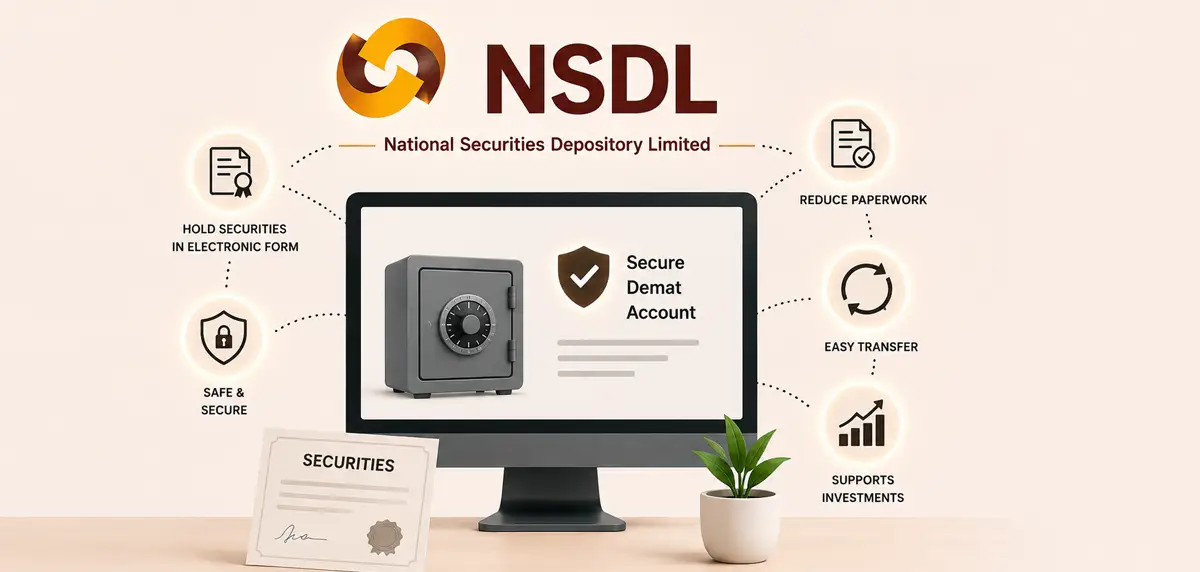







Imagine managing all your investments: shares, bonds, and mutual funds, without ever worrying about losing physical documents, dealing with paperwork delays, or facing transfer complications. Today, this level of convenience feels natural, but it wasn’t always the case.
The transformation of India’s financial markets from paper-based systems to a fully digital ecosystem has been driven by one powerful institution: National Securities Depository Limited. Understanding NSDL is not just about learning a financial term; it is more about recognising the backbone that makes modern investing smooth, secure, and efficient.
Let us explore the concept, working mechanism, services, and importance of NSDL in a simple and structured manner.
What is NSDL?
NSDL (National Securities Depository Limited), established in 1996, is India’s first electronic securities depository. It allows you to hold financial securities such as shares, bonds, mutual funds, and government securities in electronic form, eliminating the need for physical certificates.
Before NSDL, investors had to deal with paper-based share certificates, which involved risks like theft, damage, forgery, and delays in transfer. With the introduction of NSDL, the entire process became digitised, secure, and seamless.
Today, NSDL plays a crucial role in strengthening India’s capital markets by ensuring transparency, efficiency, and safety in transactions.
NSDL vs CDSL- Key Differences
While understanding NSDL, it is equally important to differentiate it from CDSL (Central Depository Services Limited), as both serve similar purposes in India’s financial ecosystem but operate independently.
Parameter | NSDL | CDSL |
Established | 1996 | 1999 |
Promoted by | NSE, IDBI Bank, UTI | BSE, banks |
Market Position | First depository in India | Second depository |
DP Network | More institutional DPs | Wider retail penetration |
Account Numbers | Begin with "IN" (16 digits, alphanumeric) | 16 Digits, numeric format |
Primary Exchange | Works primarily with the NSE | Works with the BSE |
Usage | Preferred by large institutions | Popular among retail investors |
Both NSDL and CDSL are regulated by SEBI and provide similar services such as dematerialisation, account maintenance, and transaction settlement. As an investor, your choice depends on your Depository Participant rather than a direct selection.
How Does NSDL Work?
To understand what NSDL is, it is important to know how it operates within the financial system.
1. Depository System
NSDL functions similarly to a bank, but instead of holding money, it holds your securities. You open a Demat account through a Depository Participant (DP), which acts as an intermediary between you and NSDL.
2. Dematerialisation
Physical share certificates are converted into electronic form through a process called dematerialisation. This ensures easier storage, transfer, and tracking of investments.
3. Role of Intermediaries
NSDL works with intermediaries such as stockbrokers, banks, and financial institutions known as Depository Participants. These entities provide services to investors on behalf of NSDL.
4. Electronic Transfers
Buying or selling securities involves simple electronic entries in your Demat account. This eliminates paperwork and reduces settlement time significantly.
Key Services Offered by NSDL
Once you complete NSDL registration, you gain access to a wide range of digital services designed to simplify investment management.
Consolidated Account Statement (CAS)
You can download and view a single statement that reflects all your holdings across equities, mutual funds, and other securities.
Portfolio Tracking
NSDL allows you to track your entire investment portfolio in one place, making it easier to monitor performance.
SPEED-e Facility
This feature enables you to submit delivery instructions online for transferring shares, ensuring convenience and speed.
Transaction Monitoring
You can review your transaction history, monitor capital gains, and maintain accurate financial records.
These services make NSDL an essential tool for modern investors looking for efficiency and transparency.
Step-by-Step Process for NSDL Registration
Registering for NSDL e-services is a straightforward process. Here is how you can get started:
Step 1. Visit the official NSDL e-services portal
Step 2. Select “New User Registration”
Step 3. Fill in the required personal and Demat account details
Step 4. Create your user ID and password
Step 5. Verify your details using the OTP sent to your registered mobile and email
Step 6. Your request is sent to your Depository Participant for approval
Step 7. Once approved, you receive a confirmation email
After registration, you can log in and manage your investments digitally.
Importance of PAN Verification
PAN (Permanent Account Number) verification is mandatory for all NSDL account holders. As per guidelines by the Securities and Exchange Board of India, accounts without valid PAN verification cannot be operated.
This requirement ensures transparency, prevents fraud, and strengthens compliance within the financial system.
NSDL and PAN Card Services
Apart from depository services, NSDL also facilitates PAN card applications through its platform (now managed under Protean services).
How to Apply for a PAN Card Online
Step 1. Visit the official PAN services portal
Step 2. Select the appropriate application type
Step 3. Fill in the required details
Step 4. Upload documents or send them via post
Step 5. Pay the application fee
Step 6. Receive an acknowledgement number to track your application
Tracking PAN Status
You can track your PAN application using the 15-digit acknowledgement number through the NSDL portal.
Why is NSDL Important for Investors?
NSDL has transformed the investment landscape in India by offering several advantages, such as:
1. Enhanced Security
Electronic holding eliminates risks associated with physical certificates, such as loss, theft, or forgery.
2. Faster Transactions
Settlement cycles are significantly reduced, enabling quicker buying and selling of securities.
3. Transparency
Every transaction is recorded digitally, ensuring complete transparency and accountability.
4. Convenience
You can manage your investments anytime and anywhere through online platforms.
Role of NSDL in KYC and Insurance
NSDL plays a central role in linking various financial processes, making it a key enabler of seamless onboarding across investment and insurance platforms.
- KYC Compliance:
NSDL supports KYC validation, ensuring regulatory compliance and reducing fraud risks
- Demat Connectivity:
A Demat account linked with NSDL enables easy tracking of financial assets, which is often required during insurance underwriting for high-value policies
- Insurance Onboarding:
Insurers may rely on verified financial and identity records (such as PAN and KYC linked through NSDL systems) to streamline policy issuance
This interconnected ecosystem ensures that whether you are investing in securities or purchasing insurance, your identity, financial data, and compliance records are securely verified and easily accessible.
NSDL and Life Insurance
NSDL acts as an Insurance Repository (NIR) through its subsidiary, allowing individuals to hold life insurance policies in electronic form (eIA - e-Insurance Account). This digital approach simplifies managing multiple policies, offering safety, easy access, and conversion of physical policies to digital.
Here are some key aspects of NSDL and life insurance:
- e-Insurance Account (eIA):
NSDL (via NDML) allows opening an e-Insurance Account to hold all life, health, and general insurance policies in one place.
- Digital Convenience:
Policies are converted from physical to digital, eliminating the risk of losing papers and ensuring safe custody.
- Service and Management:
The NIR serves as a single point for servicing all e-policies, making periodic monitoring easy.
- Consolidated View:
You can view details of all your e-insurance policies in one consolidated account statement.
NSDL vs Physical Securities
The following comparison highlights why dematerialisation through NSDL is the preferred choice today.
Aspect | NSDL (Demat Form) | Physical Certificates |
Safety | Highly secure | Prone to loss/damage |
Transfer | Quick and electronic | Time-consuming |
Storage | Digital | Physical storage required |
Transparency | High | Limited |
Cost | Lower long-term cost | Higher handling cost |
Is NSDL Safe?
NSDL is highly secure and operates under strict regulatory supervision by SEBI. It follows advanced encryption and cybersecurity protocols to protect investor data and transactions.
However, you should always ensure that you use official platforms and avoid sharing sensitive information to prevent fraud.
Common Mistakes to Avoid
While using NSDL services, you should be mindful of the following:
- Not updating KYC details regularly
- Ignoring account statements
- Sharing login credentials
- Using unofficial websites for transactions
Being cautious can help you maximise the benefits of NSDL securely.
Conclusion
NSDL has revolutionised the way investments are held and managed in India. By eliminating paperwork and introducing electronic systems, it has made investing more accessible, efficient, and secure. Think of it as the backbone of India’s modern investment ecosystem, ensuring your financial assets are safe, organised, and easy to manage.
As you plan your financial future, combining the facilities of NSDL for investments and instruments such as a life insurance policy can help you achieve both growth and protection.