Customers
  Distributor
  Join us as an Advisor
  Employee













































 :
:  :
:  :
: 









Key Takeaways
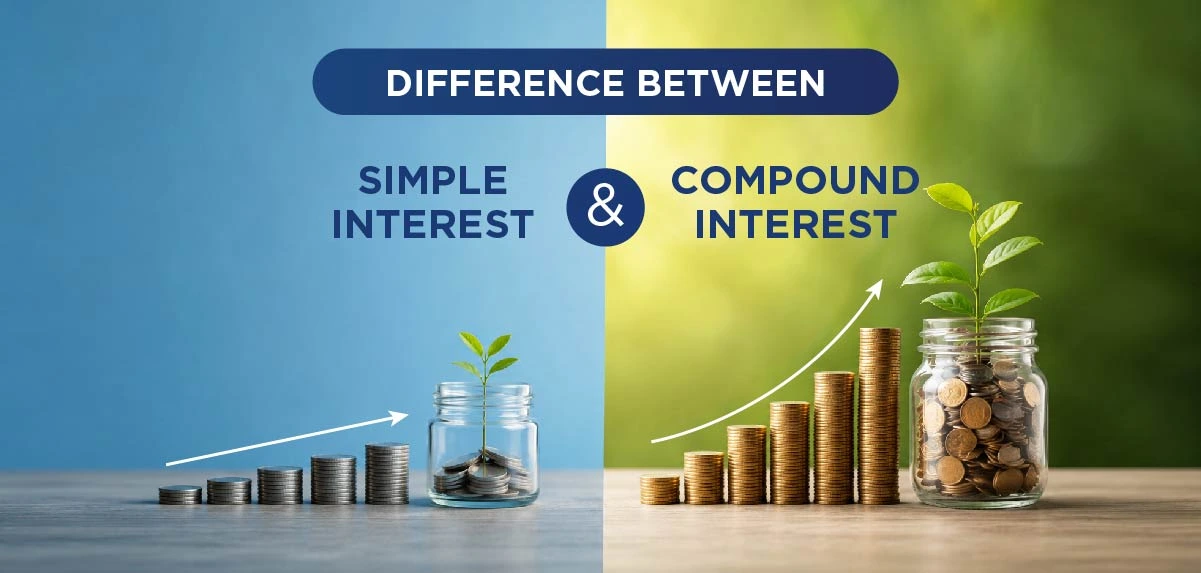
- In compound interest, the interest gets earned not just on the principal amount but also on the interest earned, and thus it is a better way of generating money for the future.
- Simple interest is based solely on the initial investment made by the person; the returns would continue to be the same for all periods of investment.
- Compounding will increase with the passage of time, and thus starting investments early will have an impact on the future.
- Long-term savings or investment-based life insurance policies may enjoy the benefits of compounding over time.
- Knowledge about the two types of interest can help you decide upon a life insurance policy for yourself.
Imagine two parents planning for their child's higher education through a long-term life insurance solution. Both share the same financial goal, but one starts investing ten years earlier. That extra time gives their savings a greater opportunity to benefit from the power of compounding.
This basic example highlights the importance of knowing the difference between simple interest and compound interest. Although life insurance products are meant to provide financial security, there are some savings- and investment-oriented life insurance products that can be used to create wealth in the future. Knowing how your money grows can help you compare these plans more confidently and choose one that aligns with your financial goals.
What is Compound Interest in Life Insurance?
Compound interest refers to the way in which returns are earned on both the initial investment and the interest earned in previous periods. This means your investment has the potential to grow faster over time, as each interest period builds on the previous one.
This concept is known as the power of compounding. The longer the investment period, the greater the potential impact of compounding. For life insurance buyers, it is particularly relevant when evaluating long-term savings-oriented and investment-linked life insurance plans.
The compounding process works better if the investments stay put for longer periods. It is not just about maximizing gains but also about allowing the investment enough time to accumulate value. This is one of the major reasons why people in the finance world usually recommend early investments rather than waiting until major life goals are closer.
Why is Understanding the Difference Between Simple Interest and Compound Interest Important for Life Insurance?
The difference between simple interest and compound interest is important because the method used to calculate returns can lead to different financial outcomes. Over shorter investment periods, the difference may seem minimal. However, over the long term, the gap can become much more significant.
If your goal is retirement planning or funding your child's higher education, understanding how returns accumulate can help you evaluate life insurance options more effectively. It also enables you to choose a plan that aligns with your long-term financial goals.
What is Simple Interest and How Does it Work?
Simple interest is calculated only on the original principal amount throughout the investment period. The interest earned is not added to the principal for future calculations.
The formula for computing simple interest is:
Simple Interest = (Principal × Rate × Time) ÷ 100
For instance, if you invest ₹5,00,000 at an interest rate of 8% per annum for 10 years, the interest is calculated only on the original principal amount. Hence, the major difference between simple and compound interest is that, with simple interest, the interest earned remains the same each year.
A simple interest calculator can help you estimate the total interest earned and the maturity amount based on your investment amount, interest rate, and tenure. It is a useful tool for understanding fixed and predictable returns.
Simple interest is generally suitable for short-term financial goals. Since the interest is not reinvested, it does not offer the same long-term growth potential as compound interest.
While simple interest provides certainty regarding its earnings, it doesn’t exploit the benefits of compound interest. The consequence is that there is constant growth of the investment through the entire period of investment at a steady rate. It can thus be said to be easy to understand, although it may not necessarily be the best way to go about things.
How Does Compound Interest Work in Long-Term Life Insurance Planning?
Compound interest is calculated on both the original principal amount and the interest earned in previous periods. This helps your money grow faster over time because each interest period increases the base for earning future returns.
The formula for compound interest is:
A = P (1 + r/n)nt
Here, P is the principal, r is the interest rate per annum, n is the number of times the interest is compounded per year, and t is the period of investment.
A compound interest calculator can assist you in calculating how your investment will grow during various periods of time. It also helps you better understand the difference between simple interest and compound interest and why starting your investment journey early can make a significant difference.
This explains why the power of compounding is closely associated with long-term financial planning. Savings-oriented life insurance plans and ULIPs are generally designed for longer policy tenures, giving your investment more time to grow, subject to the policy's features and market performance.
For instance, an individual who starts investing at the age of thirty whose investment horizon will be longer compared to that of another investor who begins to make investments at the age of forty. Although they may invest almost the same amount, the extra years will give the chance of compounding the work in favour of better gains.
Simple Interest vs. Compound Interest: Key Differences Explained
Understanding the difference between compound interest and simple interest formulas is only the first step. The more important distinction lies in how each method supports your long-term financial goals.
Basis | Simple Interest | Compound Interest |
Interest calculation | On the original principal only | On the principal and accumulated interest |
Growth pattern | Steady and linear | Accelerates over time |
Return potential | Lower over longer periods | Higher growth potential over longer periods |
Best suited for | Short-term financial needs | Long-term financial planning |
Interest reinvestment | No | Yes |
When comparing compound vs. simple interest, compound interest generally offers greater long-term growth because your returns continue to earn additional returns over time.
In addition, time plays another crucial factor when it comes to the difference between simple interest and compound interest. In the case of simple interest, the longer you invest, the more money you earn, but at a constant pace. The case of compound interest is different; every extra year allows you to make even more money from your previous earnings.
Which Life Insurance Plans Can Benefit from the Power of Compounding?
There are various kinds of life insurance policies meant for various financial requirements. Knowing these differences will help you decide on the most appropriate policy for you.
Term Insurance is an insurance policy that is purely designed to offer financial protection. Savings-oriented life insurance plans combine life cover with disciplined savings. ULIPs combine insurance with market-linked investments and are designed for long-term financial planning. Since these plans are typically held for longer durations, they may benefit from the power of compounding, subject to the policy's features and market performance.
If your goal is to build a corpus for retirement or your child's future milestones, understanding the difference between simple interest and compound interest can help you make a more informed decision. If you're looking for a solution that combines life cover with long-term financial planning, you can explore savings-oriented and investment-linked life insurance plans to find one that suits your financial goals.
Is Compound Interest Better Than Simple Interest for Long-Term Financial Goals?
For long-term financial planning, compound interest generally offers greater growth potential. It allows your savings to grow on both the original investment and the accumulated returns.
Simple interest remains relevant. It is better suited for situations where predictable interest calculations are the priority or where the investment period is relatively short.
When choosing life insurance, you need to select a package that matches your financial objectives and the kind of policy you need. Understanding simple interest vs. compound interest can help you evaluate the best life insurance solutions available to support both financial protection and long-term financial planning.
What Mistakes Should You Avoid When Comparing Simple and Compound Interest?
Many people focus only on the interest rate without considering the investment period. However, time is one of the most important factors that influence the power of compounding.
Moreover, to further understand the difference between simple interest and compound interest, it is equally essential to know the purpose of your life insurance policy. Term insurance emphasizes safety, whereas the savings and investment plans help meet long-term financial goals. It may not be possible to compare the plans without knowing the purposes, since it will create unreal expectations. With the help of a compound calculator and a simple interest calculator, it will be easier to compare the financial situations.
Understanding Compound Interest Can Help You Choose the Right Life Insurance Plan
Knowing the difference between simple interest and compound interest is not just about understanding basic financial concepts. It also helps in understanding the various solutions for life insurance coverage and financial protection, along with wealth creation.
Regardless of whether you opt for a term plan that offers protection purely from a financial standpoint or look into savings-based and investment-based life insurance options, knowledge of simple interest versus compound interest will prove useful. Getting started early on, leveraging the power of compounding, you can build a stronger financial foundation for yourself and your loved ones.