Customers
  Distributor
  Join us as an Advisor
  Employee













































 :
:  :
:  :
: 








Key Takeaways
- India’s taxation system is broadly divided into direct taxes and indirect taxes, each impacting income, spending, and financial planning differently.
- Direct taxes such as income tax and corporate tax are paid directly to the government, while indirect taxes like GST are included in the price of goods and services.
- Proper tax planning helps individuals and businesses reduce liabilities, improve compliance, and achieve better financial management through deductions and investments.
- Timely tax payment supports national development, avoids penalties, and ensures financial credibility for loans, investments, and future financial opportunities.
Taxes form the backbone of a nation’s economic system. In India, they play a vital role in funding infrastructure, public services, and welfare programmes. If you have ever wondered what a tax is and how it impacts your daily life, understanding the types of taxes in India is the first step towards better financial awareness and planning.
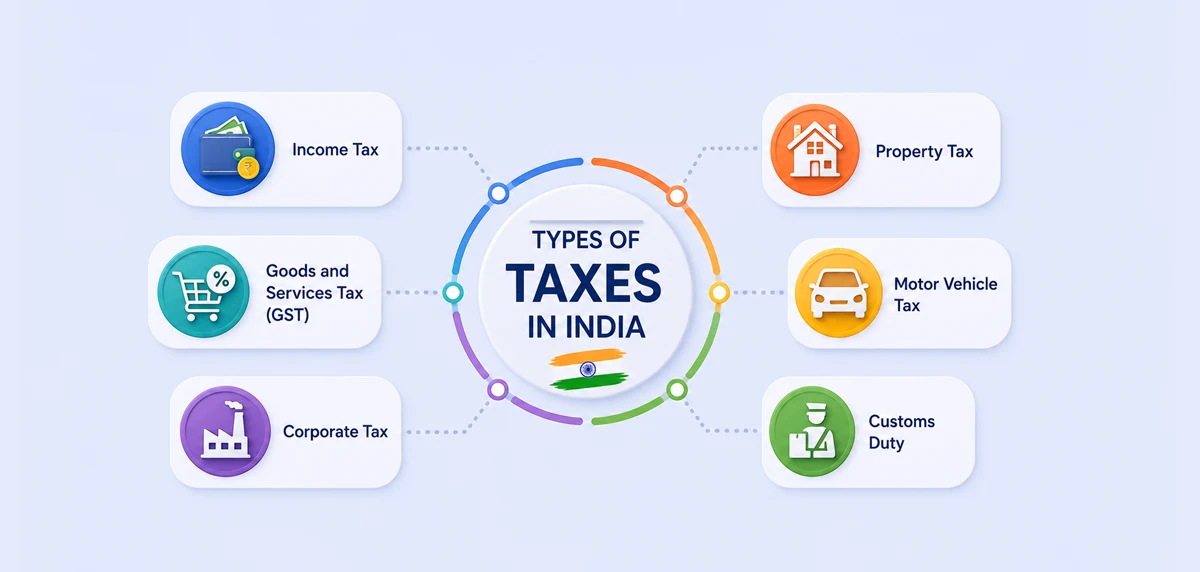
India follows a well-structured taxation system with contributions from the Central Government, State Governments, and local authorities. Let’s explore the different types of tax in India, how they work, and what they mean for you.
Understanding the Tax Structure in India
The types of taxation in India are broadly divided into two main categories:
- Direct Taxes
- Indirect Taxes
While direct taxes are paid directly by individuals or entities on their income, indirect taxes are applied to goods and services and are ultimately borne by consumers.
This classification helps you understand how taxes affect both your earnings and your spending habits.
What are Direct Taxes?
Direct taxes are imposed directly on individuals, Hindu Undivided Families (HUFs), and companies. These taxes cannot be transferred to another person.
Key Features:
- Paid directly to the government
- Based on income or profit
- Cannot be shifted to others
Major Types of Direct Taxes in India
1. Income Tax
This is the most common direct tax. If your income exceeds the prescribed limit in a given tax year, you are required to pay tax as per applicable slab rates.
- Based on income slabs
- Applicable to salaried individuals, professionals, and businesses
- You can reduce liability through deductions and exemptions
Understanding what is income tax helps you plan your finances better and optimise savings using tools like a tax calculator.
2. Capital Gains Tax
This tax is levied on profits earned from the sale of assets such as shares, property, or gold.
- Short-Term Capital Gains (STCG): Applicable when assets are sold within a specified period
- Long-Term Capital Gains (LTCG): Applicable for assets held longer
Indexation benefits may reduce taxable gains in some cases.
3. Corporate Tax
Corporate tax is applicable to companies on their net profits.
- Rates vary based on turnover and chosen provisions
- Special rates apply under Sections 115BAA and 115BAB
- Includes surcharge and cess
Corporate tax plays a key role in shaping business decisions and economic growth.
4. Securities Transaction Tax (STT)
STT is charged on the purchase and sale of securities listed on stock exchanges.
- Applicable on shares, mutual funds, and derivatives
- Helps streamline taxation on stock market transactions
What are Indirect Taxes?
Indirect taxes are levied on goods and services. These taxes are collected by businesses and passed on to consumers.
Key Features:
- Paid indirectly by consumers
- Included in the price of goods/services
- Collected by intermediaries
Major Types of Indirect Taxes in India
1. Goods and Services Tax (GST)
GST is the most important reform in the Indian tax system. It replaced multiple indirect taxes with a single unified structure.
GST Components:
- CGST (Central GST): Collected by the Central Government
- SGST (State GST): Collected by State Governments
- IGST (Integrated GST): Applicable on inter-state transactions
GST Rate Structure (Post-2025 Reforms):
- 5%: Essential goods
- 18%: Standard goods and services
- 40%: Luxury and sin goods
GST has simplified compliance and reduced cascading taxes.
2. Customs Duty
This tax is levied on goods imported into or exported from India.
- Protects domestic industries
- Generates revenue for the government
3. Stamp Duty
Stamp duty is charged on legal documents such as property transactions.
- Varies across states
- Mandatory for property registration
4. State-Level Taxes (Outside GST)
Some taxes continue to exist outside GST, such as:
- State excise duty (on alcohol)
- Professional tax
- Property tax
Direct vs Indirect Taxes: Key Differences
Feature | Direct Tax | Indirect Tax |
Who Pays | Individuals/Businesses | Consumers |
Burden | Cannot be transferred | Can be transferred |
Basis | Income or profit | Consumption |
Examples | Income tax, corporate tax | GST, customs duty |
Importance of Taxes in India
Taxes are essential for nation-building and economic stability. Here’s why they matter:
1. Infrastructure Development
Tax revenue is used for roads, railways, and public utilities.
2. Public Services
Healthcare, education, and defence are funded through taxes.
3. Economic Growth
Tax policies influence investments, savings, and consumption.
Impact of Taxes on Individuals vs Businesses
Understanding taxation impacts on individuals and businesses is crucial, as both are governed by separate tax rules, deductions, and compliance requirements. The table below highlights the key differences:
Parameter | Individual Taxation | Business Taxation |
Tax Basis | Tax is calculated on personal income, such as salary, rent, interest, or capital gains | Tax is calculated on business profits and operational income |
Applicable Tax Rates | Based on individual income tax slabs | Based on business structure (proprietorship, partnership, company, LLP) |
Deductions Available | Section 80C, 80D, home loan benefits, etc. | Business expenses, depreciation, salaries, rent, and operational costs |
Compliance Requirement | Filing annual Income Tax Return (ITR) | Filing ITR along with GST, TDS, audits, and regulatory compliances |
Tax Planning Objective | Reduce personal tax liability and increase savings | Optimise profits, reduce tax burden, and maintain cash flow |
Example | Salaried employee claiming deductions on insurance premiums | A company claiming machinery depreciation and employee salary expenses |
Both individuals and businesses benefit from proper tax planning, as it improves financial efficiency, ensures compliance, and helps manage long-term financial goals effectively.Top of Form
Tax Planning and Compliance
Effective tax planning can help you save money while staying compliant.
Key Steps:
1. Assess your taxable income
2. Choose the right tax regime
3. Invest in tax-saving instruments
4. Maintain proper documentation
5. Use tools like a tax calculator
You can also file ITR online through the government portal, making the process simple and efficient.
What Happens if You Don’t Pay Taxes?
Non-compliance can lead to serious consequences:
- Penalties and interest charges
- Legal action in severe cases
- Loss of financial credibility
- Difficulty in getting loans or visas
Timely tax payment ensures smooth financial management and avoids unnecessary complications.
Final Thoughts
Understanding the kinds of taxes in India is essential for managing your finances effectively. From income tax to GST, each component of the system plays a specific role in shaping the economy.
Learning about all types of taxes in India helps you make informed financial decisions, optimise your tax liability, and contribute responsibly to the nation’s growth.
As tax laws evolve, staying updated will help you align your financial strategy with current regulations and ensure long-term stability.