Customers
  Distributor
  Join us as an Advisor
  Employee













































 :
:  :
:  :
: 









Key Takeaways
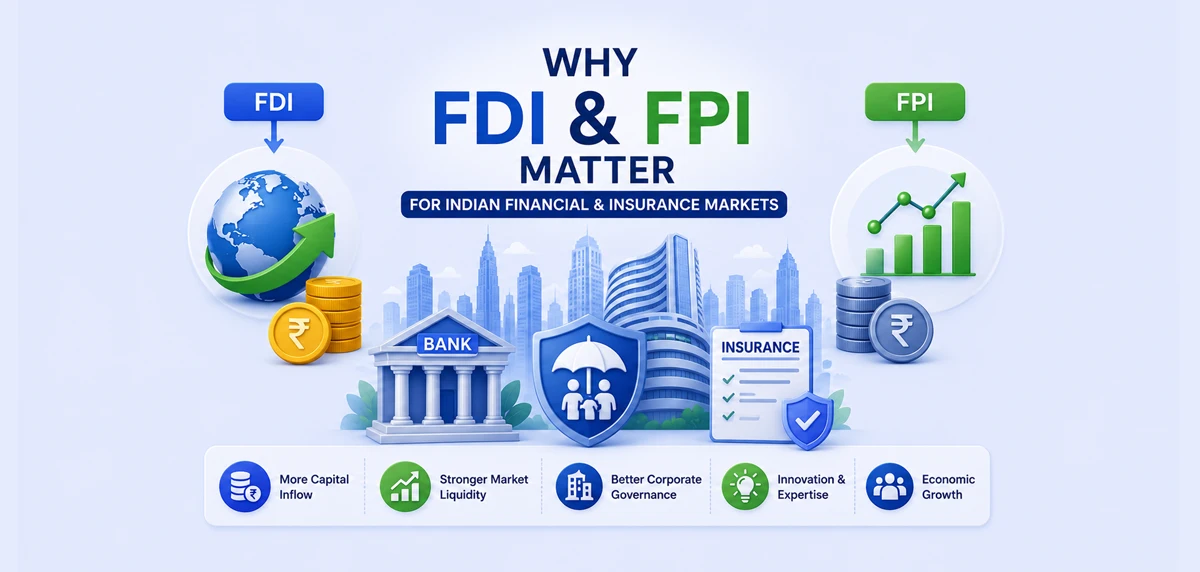
- FDI and FPI play different roles in India’s economy, with FDI supporting long-term business growth and FPI improving market liquidity and capital flows.
- Foreign investments strengthen the insurance sector by improving solvency, encouraging product innovation, enhancing digital services, and expanding insurance accessibility across India.
- Insurance buyers benefit indirectly through better claim settlement capabilities, competitive pricing, improved customer experience, and financially stronger insurers offering long-term policy stability.
- Balanced foreign participation continues to support India’s financial ecosystem through technology transfer, market development, infrastructure growth, and increased investor confidence.
India’s financial sector has witnessed rapid growth over the last two decades, supported by digitalisation, regulatory reforms, and significant foreign investments. Two major sources of international capital that influence this growth are Foreign Direct Investment (FDI) and Foreign Portfolio Investment (FPI). While both bring foreign money into the economy, they function differently and impact industries in distinct ways.
Understanding the difference between FDI and FPI is particularly important in the insurance sector. Foreign investments not only affect stock markets and businesses but also influence insurance solvency, product innovation, pricing, and customer experience. If you are purchasing a life insurance policy, evaluating investment plans, or planning long-term financial security, these foreign capital flows indirectly shape the products and services available to you.
Understanding FDI and FPI
Before analysing their impact on insurance and financial markets, it is important to understand what FDI and FPI mean.
What is Foreign Direct Investment (FDI)?
Foreign Direct Investment refers to long-term investment by a foreign entity in a company or business located in another country. In India, FDI often involves foreign companies acquiring ownership stakes, establishing subsidiaries, or entering joint ventures.
Examples of FDI include:
- Foreign insurers partnering with Indian insurance companies
- International firms investing in Indian fintech or banking sectors
- Global corporations establishing manufacturing or technology operations in India
FDI generally involves:
- Long-term commitment
- Active management participation
- Transfer of technology and expertise
- Infrastructure and business development
What is Foreign Portfolio Investment (FPI)?
Foreign Portfolio Investment refers to investments made by foreign investors in financial assets such as stocks, bonds, and exchange-traded funds (ETFs).
Unlike FDI, FPI investors usually do not participate in management decisions. Their objective is mainly financial returns through capital appreciation or interest income.
Examples include:
- Foreign institutional investors buying Indian insurance company shares
- Overseas funds investing in Indian stock markets
- Global investors purchasing Indian government or corporate bonds
FPI investments are:
- Market-linked
- Relatively short-term
- Easier to enter and exit
- More sensitive to global economic conditions
FDI vs FPI: Key Differences
Understanding FDI and FPI differences help investors and policyholders better understand how foreign capital influences the economy.
Parameter | FDI | FPI |
Nature of Investment | Direct ownership in businesses | Investment in financial securities |
Investment Horizon | Long-term | Short to medium-term |
Control | High management involvement | Passive investment |
Risk Stability | Relatively stable | More volatile |
Liquidity | Difficult to exit quickly | Easy to buy and sell |
Objective | Business expansion and growth | Financial returns |
Impact on Economy | Structural and long-term | Market liquidity and capital flows |
This difference between FDI and FPI becomes particularly important in sectors like insurance, where long-term stability is critical.
Why Does the Insurance Sector Depend on Foreign Investments?
Insurance is a capital-intensive industry. Companies must maintain strong financial reserves to settle claims, manage risks, and comply with solvency regulations set by the Insurance Regulatory and Development Authority of India (IRDAI).
Foreign investments help insurers:
- Increase capital reserves
- Expand distribution networks
- Improve digital infrastructure
- Develop innovative insurance products
- Strengthen claim settlement capabilities
India has gradually liberalised foreign investment norms in insurance to encourage global participation and improve industry growth.
How FDI Impacts Indian Insurance Markets
1. Improves Insurance Solvency
One of the biggest benefits of FDI in insurance is stronger solvency.
Insurance companies are legally required to maintain sufficient capital to pay future claims. Foreign direct investments provide insurers with additional financial strength, helping them maintain healthier solvency ratios. But why should an insurance buyer care?
Higher solvency generally means:
- Better claim-paying ability
- Greater financial stability
- Reduced risk of insurer distress
- Improved long-term policy reliability
For policyholders purchasing a life insurance policy, financial stability of the insurer is extremely important because these products often continue for decades.
2. Encourages Product Innovation
Global insurance companies bring international expertise, technology, and advanced underwriting practices to India.
This has contributed to:
- Digital onboarding processes
- Faster claim settlements
- AI-driven risk assessment
- Customised investment plans
- Hybrid savings and protection products
Modern life insurance products today often include:
- Market-linked investment components
- Retirement income features
- Child education planning
- Health riders and critical illness benefits
Foreign participation has significantly accelerated this innovation.
3. Enhances Customer Experience
FDI has encouraged competition among insurers, leading to:
- Better customer service
- Simplified documentation
- Mobile-based policy management
- Faster policy issuance
- Improved grievance redressal
Many insurers now provide online premium calculators and investment calculator tools that help customers estimate returns, premiums, and coverage needs more accurately.
4. Expands Insurance Penetration
India still has relatively low insurance penetration compared to many developed economies. Foreign investments help insurers expand into:
- Tier-2 and Tier-3 cities
- Rural regions
- Digitally underserved markets
This improves financial inclusion and access to protection-oriented products.
How FPI Influences Financial and Insurance Markets
While FDI strengthens long-term business growth, FPI primarily impacts financial market liquidity and valuations.
1. Impacts Stock Market Movements
Insurance companies listed on stock exchanges often experience price fluctuations due to foreign portfolio investments.
When foreign investors buy Indian equities:
- Market confidence improves
- Stock prices may rise
- Capital availability increases
However, large FPI outflows can create market volatility.
2. Influences Investment Portfolios of Insurers
Insurance companies invest policyholder premiums into:
- Government bonds
- Corporate debt
- Equities
- Infrastructure assets
Market volatility caused by FPI inflows or outflows can influence the returns generated by these investments.
This is especially relevant for:
- ULIPs
- Pension products
- Market-linked investment plans
3. Affects Interest Rates and Bond Markets
FPI activity in debt markets can influence:
- Bond yields
- Liquidity conditions
- Interest rate movements
These factors indirectly impact pricing and returns of certain long-term insurance and retirement products.
Why Should an Insurance Buyer Care About FDI and FPI?
Many individuals assume foreign investments only affect stock markets. In reality, FDI and FPI influence the insurance products you purchase in multiple ways.
Better Financial Stability
Higher foreign investment strengthens insurers financially and improves long-term sustainability.
Improved Product Choices
Foreign expertise enables insurers to offer more customised and diversified products.
Competitive Pricing
Increased competition often helps optimise premium pricing and operational efficiency.
Better Technology Integration
Customers benefit from:
- Digital policy issuance
- Instant premium payments
- Online claim tracking
- AI-driven customer support
Enhanced Long-Term Confidence
When buying long-duration products such as life insurance or retirement-oriented investment plans, policyholders benefit from financially stable insurers backed by strong capital reserves.
FDI and FPI in India’s Broader Financial Ecosystem
Apart from insurance, foreign investments support:
- Banking expansion
- Fintech innovation
- Capital market development
- Infrastructure financing
- Economic growth
FDI contributes to employment generation, technology transfer, and industrial expansion, while FPI improves liquidity and market participation.
Together, FDI and FPI strengthen India’s overall financial ecosystem and attract global investor confidence.
Risks Associated with Foreign Investments
While foreign investments offer several advantages, there are also certain risks.
Risks of FPI
- Sudden capital outflows
- Market volatility
- Currency fluctuations
- Short-term speculative movements
Risks of FDI
- Regulatory dependence
- Global economic slowdown impact
- Foreign ownership concerns in strategic sectors
However, India’s regulatory framework aims to balance foreign participation with domestic financial stability.
Final Thoughts
Understanding FDI and FPI is essential because both forms of foreign investment significantly influence India’s financial and insurance markets. While FDI supports long-term growth, innovation, and solvency in the insurance sector, FPI improves market liquidity and strengthens capital markets.
For insurance buyers, these investments matter because they directly affect insurer stability, customer experience, product innovation, and pricing efficiency. As India continues expanding its financial ecosystem, balanced foreign participation will remain a critical driver of growth, stability, and innovation across banking, investments, and insurance sectors.