Customers
  Distributor
  Join us as an Advisor
  Employee













































 :
:  :
:  :
: 









Managing your finances is not only about earning and saving, but also about protecting your wealth from uncertainties. Life can present unexpected situations such as medical emergencies, accidents, or property damage, all of which can lead to financial strain. This is where understanding the types of insurance becomes essential.
With several kinds of insurance available in India, it may feel overwhelming to identify the right one. However, once you understand how each type of insurance policy works, you can make informed decisions that secure both your present and future.
What is Insurance?
To begin with, let us understand what insurance is. Insurance is a financial arrangement between an individual and an insurance provider, where the insurer agrees to compensate for specific financial losses in exchange for a premium. It works on the principle of risk sharing, ensuring that a large financial burden is reduced to manageable periodic payments.
This mechanism ensures that your savings are protected during emergencies, making insurance an important component of financial planning.
Main Types of Insurance
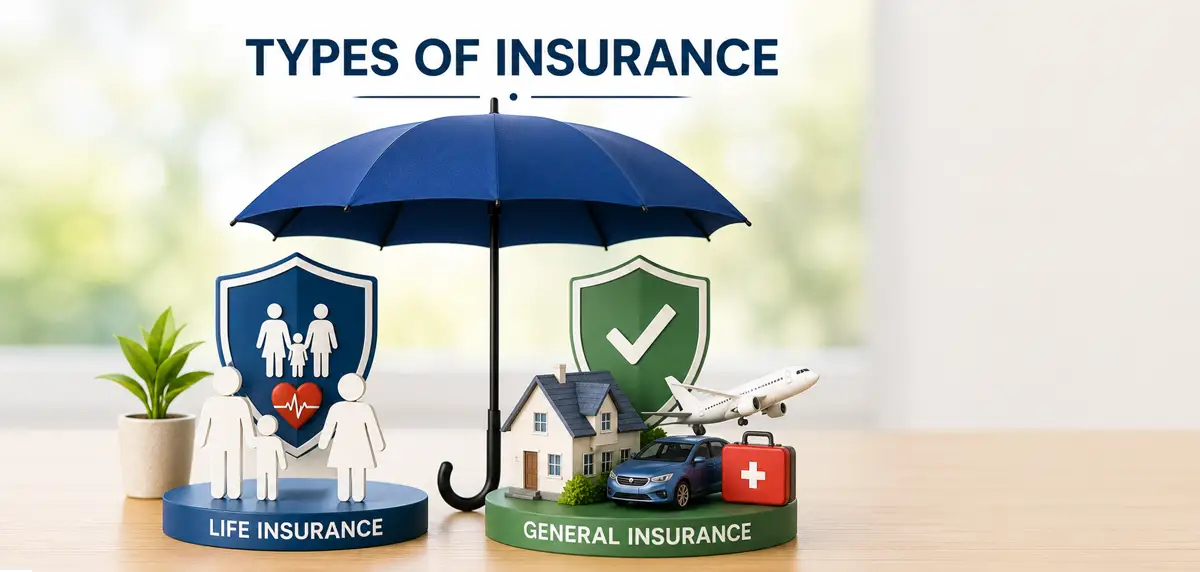
Insurance in India can broadly be categorised into two main segments:
Category | Description |
Life Insurance | Covers the risk of death and supports dependents financially |
General Insurance | Covers health, vehicle, travel, and property-related risks |
Understanding these primary kinds of insurance helps you build a well-rounded protection plan.
1. Life Insurance
If you are exploring what is life insurance, it is a policy that ensures your family’s financial security in your absence. It provides a payout (sum assured) to your nominees in case of your untimely demise.
Life insurance is considered one of the most crucial types of insurance policies, particularly if you have financial dependents.
Key Benefits of Life Insurance
Financial Security for Family
Life insurance ensures that your family continues to meet daily expenses, repay debts, and maintain their standard of living even if you are not around.
Wealth Creation and Savings
Certain policies not only provide protection but also help you build savings over time. This dual benefit makes them suitable for long-term financial planning.
Goal-Based Planning
Life insurance helps you plan for milestones such as your child’s education, marriage, or your retirement.
Understanding the benefits of life insurance is essential before choosing the life insurance policy that aligns with your goals.
Types of Life Insurance
1. Term Insurance
The term life insurance is the simplest form among all types of insurance. It offers coverage for a fixed period.
- It provides a high sum assured at a relatively low premium, making it affordable for most individuals.
- The policy pays out only if the insured passes away during the policy term.
- It is ideal for individuals looking for pure protection without any investment component.
2. Whole Life Insurance
This policy provides coverage for the entire lifetime of the insured.
- The whole life insurance ensures lifelong financial protection for your dependents.
- It builds a cash value over time, which can be borrowed against if needed.
- It is suitable for individuals looking for long-term wealth preservation.
3. Endowment Plans
Endowment plans combine insurance with savings.
- They offer a lump sum payout either on maturity or in case of the policyholder’s demise.
- These plans encourage disciplined savings over a fixed tenure.
- The endowment plans are ideal for individuals planning for future financial goals with minimal risk.
4. Unit Linked Insurance Plans (ULIPs)
The unit linked insurance plans are investment-linked insurance products.
- A portion of the premium is used for life cover, while the rest is invested in market-linked funds.
- They offer the flexibility to choose between equity, debt, or balanced funds.
- ULIPs are suitable for individuals willing to take moderate risks for higher returns.
5. Child Plans
Child insurance plans are designed to secure your child’s future.
- They ensure that financial goals such as education or marriage are not affected by uncertainties.
- Many child plans include a premium waiver benefit in case of the parent’s death.
- They provide peace of mind by safeguarding your child’s aspirations.
6. Pension Plans
Pension plans help you build a retirement corpus.
- They allow you to save regularly during your working years.
- After retirement, pension plans provide a steady income stream.
- They ensure financial independence in your later years.
2. General Insurance
General insurance includes all non-life insurance products. These types of insurance policies protect your health, assets, and liabilities.
A. Health Insurance
Health insurance is one of the most important kinds of insurance due to increasing medical costs.
It covers hospitalisation, treatment, and medical expenses, ensuring that healthcare costs do not affect your financial stability.
Types of Health Insurance
1. Individual Health Insurance
- This policy covers a single individual.
- The entire sum insured is available exclusively for that person.
- It is suitable for individuals seeking personalised coverage.
2. Family Floater Insurance
- A single policy covers multiple family members.
- The sum insured is shared among all members.
- It is cost-effective and simplifies policy management.
3. Critical Illness Insurance
- Provides a lump sum amount upon diagnosis of serious illnesses.
- Covers diseases such as cancer, heart conditions, or kidney failure.
- Helps manage expensive treatments and lifestyle changes.
4. Senior Citizen Health Insurance
- Designed specifically for individuals above 60 years.
- Covers age-related ailments and hospitalisation.
- Provides financial support during medical emergencies in old age.
5. Group Health Insurance
- Offered by employers to employees.
- Covers medical expenses for employees and sometimes their families.
- It is economical but may have limited coverage.
6. Maternity Health Insurance
- Covers expenses related to pregnancy and childbirth.
- Includes prenatal and postnatal care.
- Also covers the newborn for a specified period.
7. Personal Accident Insurance
- Provides compensation for accidental injuries or death.
- Covers disabilities caused by accidents.
- Acts as an additional financial safety net.
B. Motor Insurance
Motor insurance is a mandatory requirement in India and one of the most widely used types of insurance.
It protects your vehicle from damages due to accidents, theft, or natural disasters.
Types of Motor Insurance
Type | Details |
Car Insurance | Covers damages to cars and third-party liabilities |
Bike Insurance | Covers two-wheelers against accidents and theft |
Commercial Vehicle Insurance | Covers vehicles used for business purposes |
Benefits of Motor Insurance
Financial Protection Against Damages
Motor insurance covers repair costs resulting from accidents, reducing your out-of-pocket expenses.
Third-Party Liability Coverage
It protects you against legal liabilities arising from injury or damage to another person or property.
Legal Compliance
Having motor insurance is mandatory under Indian law, ensuring you avoid penalties.
C. Home Insurance
Home insurance protects your house and belongings against risks such as fire, theft, and natural disasters.
Types of Home Insurance
1. Structure Insurance
- Covers the physical structure of the house.
- Includes walls, roof, plumbing, and fixtures.
- Helps rebuild the home after damage.
2. Contents Insurance
- Covers personal belongings inside the house.
- Includes furniture, electronics, and valuables.
- Ensures compensation for damaged or stolen items.
3. Burglary and Theft Insurance
- Covers losses due to theft or burglary.
- Also includes damages caused during break-ins.
- Provides financial relief during unexpected incidents.
4. Tenants’ Insurance
- Designed for renters.
- Covers personal belongings and liability.
- Also provides additional living expenses if required.
5. Landlords’ Insurance
- Protects property owners renting out their property.
- Covers structural damage and loss of rental income.
- Includes liability protection.
6. Liability Coverage
- Covers legal costs if someone is injured on your property.
- Includes compensation and legal expenses.
- Acts as a safeguard against lawsuits.
D. Fire Insurance
Fire insurance is a specialised type among the various kinds of insurance that covers losses caused by fire.
Types of Fire Insurance
- Valued Policy
- Specific Policy
- Floating Policy
- Consequential Policy
- Replacement Policy
- Comprehensive Policy
Benefits
- Covers damage caused by fire and related risks
- Helps rebuild property or business
- Provides financial stability during major losses
E. Travel Insurance
Travel insurance protects you from unforeseen events during trips.
Types of Travel Insurance
1. Domestic Travel Insurance
- Covers travel within India
- Includes medical emergencies and trip interruptions
2. International Travel Insurance
- Covers overseas travel
- Includes medical evacuation and repatriation
3. Individual Travel Insurance
- Designed for solo travellers
- Provides customised coverage
4. Student Travel Insurance
- Covers students studying abroad
- Includes study interruption and sponsor protection
5. Senior Citizen Travel Insurance
- Covers elderly travellers
- Includes enhanced medical benefits
6. Family Travel Insurance
- Covers entire family under one policy
- Simplifies management and reduces cost
Benefits of Buying Insurance Online
Buying insurance online has become increasingly popular due to its convenience and transparency.
Lower Premium Costs
Online purchases eliminate intermediary commissions, making policies more affordable.
Convenience and Accessibility
You can compare and buy different types of insurance policies anytime without visiting a branch.
Easy Comparison
Digital platforms allow you to compare multiple plans, helping you choose the best option.
Transparency
Policy details, inclusions, and exclusions are clearly mentioned, ensuring informed decisions.
Faster Processing
Minimal paperwork leads to quicker approvals and policy issuance.
Factors to Consider Before Buying Insurance
Choosing the right plan requires careful evaluation of several factors.
1. Assess Your Needs
Understand your financial responsibilities and risks before selecting from various types of insurance.
2. Claim Settlement Ratio
Choose insurers with a high claim settlement ratio for reliability.
3. Policy Exclusions
Always review exclusions to avoid misunderstandings during claims.
4. Premium Affordability
Ensure that the premium fits your budget for long-term sustainability.
5. Insurer Reputation
Opt for a trusted provider when selecting the best life insurance company in India.
Conclusion
Understanding the different types of insurance is essential for building a secure financial future. From life insurance that protects your family to general insurance that safeguards your assets, each policy plays a unique role.
By exploring various kinds of insurance and evaluating your needs, you can select the most suitable types of insurance policy for comprehensive protection.
A well-chosen insurance plan not only protects your finances but also provides peace of mind, ensuring that you are prepared for life’s uncertainties.