Customers
  Distributor
  Join us as an Advisor
  Employee













































 :
:  :
:  :
: 









Key Takeaways
- Electronic Funds Transfer (EFT) enables secure and paperless transfer of money through digital banking channels such as NEFT, RTGS, IMPS, and UPI.
- NEFT is suitable for routine transfers, RTGS is ideal for high-value urgent payments, while IMPS offers instant transfers for everyday banking needs.
- EFT systems provide convenience, speed, lower transaction costs, and enhanced security through encryption and multi-factor authentication.
- Understanding different EFT modes helps individuals and businesses choose the right payment method for efficient financial management and seamless digital transactions.
Handling money today is no longer limited to visiting a bank or dealing with cash and cheques. With the rise of digital banking, you now have the ability to move funds instantly, securely, and from virtually anywhere. At the heart of this transformation lies electronic funds transfer (EFT) like the NEFT, RTGS, IMPS, and UPI: A system that powers everything from your daily UPI payments to salary credits and online purchases.
Understanding how EFT transfer works is essential, not just for convenience but also for better financial control. Whether you are paying bills, managing investments, or sending money to loved ones, knowing what EFT means, along with its applications, can help you make faster and smarter financial decisions.
What is Funds Transfer through NEFT/RTGS/IMPS?
Electronic Funds Transfer, commonly referred to as EFT, is a method of transferring money electronically via NEFT/RTGS/IMPS from one bank account to another without the use of physical cash or paper-based instruments like cheques.
In simple terms, if you have ever used mobile banking, net banking, or digital payment apps, you have already experienced an EFT transfer. This fund transfer method refers to any digital movement of money initiated through electronic systems.
With the increasing adoption of digital banking in India, EFT electronic funds systems have become the backbone of modern financial transactions, offering speed, convenience, and security.
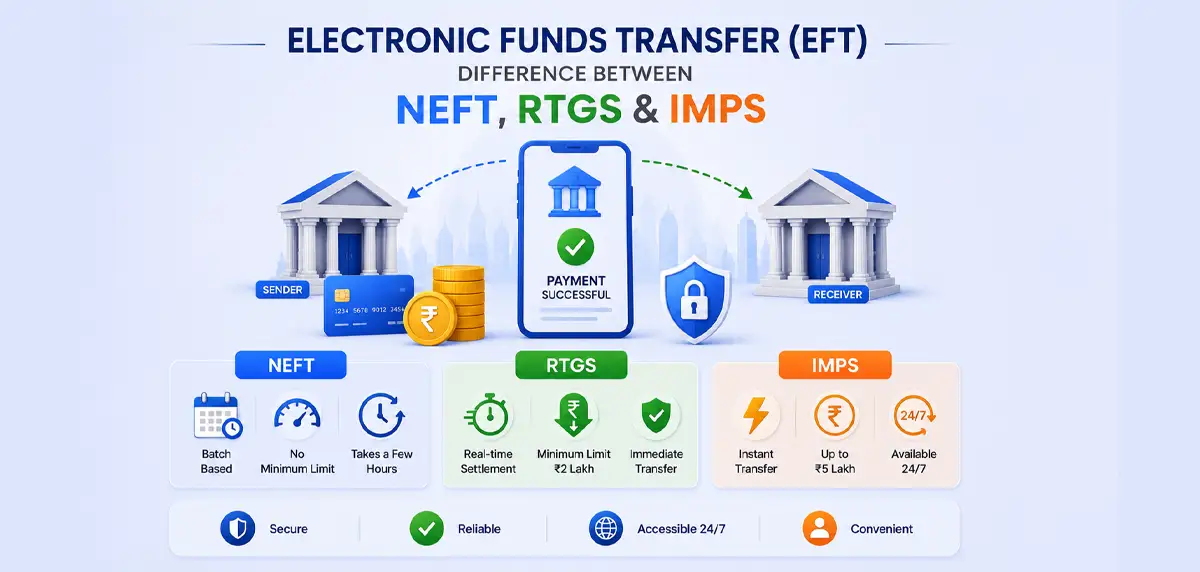
Difference between NEFT, RTGS, and IMPS
Understanding the difference between NEFT, RTGS, and IMPS can help you select the most suitable digital payment method based on speed, transaction amount, and urgency.
Parameter | NEFT | RTGS | IMPS |
Transfer Type | Batch-based transfer | Real-time transfer | Instant transfer |
Minimum Amount | No minimum limit | ₹2 lakh and above | No minimum limit |
Processing Speed | Settled in batches | Immediate settlement | Instant settlement |
Availability | 24x7 | 24x7 | 24x7 |
Best Used For | Routine fund transfers | High-value urgent transactions | Quick everyday transfers |
Transaction Limit | Bank-specific | No upper limit | Bank-specific |
Settlement Method | Deferred net settlement | Gross settlement | Immediate settlement |
Types of Electronic Funds Transfer
There are multiple types of electronic funds transfer available to cater to different financial needs. Each type offers unique features in terms of speed, cost, and usage.
1. IMPS (Immediate Payment Service)
IMPS enables instant fund transfers 24/7, including weekends and holidays. It is ideal for urgent transactions and can be done using mobile banking or internet banking.
2. NEFT (National Electronic Funds Transfer)
NEFT is a widely used EFT system that processes transactions in batches. It is suitable for non-urgent transfers and is available round the clock in India.
3. RTGS (Real Time Gross Settlement)
RTGS is used for high-value transactions, typically above ₹2 lakh. Transfers are processed individually in real time, making it ideal for large payments.
4. UPI (Unified Payments Interface)
UPI has revolutionised digital payments in India. It allows instant money transfer using a mobile device without sharing bank details, making it one of the most popular EFTs today.
5. Debit and Credit Card Transactions
Whenever you swipe or tap your card at a store or make an online purchase, it is processed as an electronic funds transfer.
6. ATM Transactions
Withdrawing cash from an ATM is also a form of EFT, where funds are electronically debited from your account.
7. Direct Deposits
Employers use EFT to credit salaries directly into employees’ bank accounts. This ensures timely and secure payments.
8. Wire Transfers
Wire transfers are commonly used for international transactions. Though slightly expensive, they are fast and reliable.
How Does a Money Transfer via NEFT/RTGS/IMPS Work?
The process of an EFT transfer is simple and highly secure. Here is how it works step by step:
1. Initiation:
You initiate the transaction via mobile banking, internet banking, or a payment app.
2. Authentication:
The bank verifies your identity using OTP, PIN, or other security measures.
3. Processing:
Your bank sends the payment request through a secure network.
4. Transfer:
The recipient’s bank receives the request and credits the amount.
5. Confirmation:
Both sender and receiver receive confirmation of the transaction.
This entire process may take a few seconds (UPI, IMPS) or a few hours (NEFT), depending on the type of EFT used.
Benefits of Funds Transfer through NEFT/RTGS/IMPS
The growing popularity of electronic funds via NEFT/RTGS/IMPS systems is driven by several advantages that make financial transactions seamless and efficient.
1. Convenience
EFT allows you to transfer money anytime and anywhere without visiting a bank branch. This flexibility is especially useful for busy professionals.
2. Speed
Most EFTs, such as UPI and IMPS, offer instant transfers, ensuring that funds reach the recipient within seconds.
3. Cost-Effective
Compared to traditional banking methods, EFT transactions are either free or involve minimal charges, making them economical.
4. Enhanced Security
Modern EFT systems use encryption, OTP verification, and multi-factor authentication to ensure safe transactions.
5. Paperless Transactions
Since EFT eliminates the need for cheques and cash, it supports a more sustainable and eco-friendly financial system.
Are Fund Transfers via NEFT/RTGS/IMPS Safe?
Yes, electronic funds transfer systems are considered highly secure. Banks and financial institutions use advanced technologies such as:
- Data encryption
- Secure servers
- Two-factor authentication
- Fraud detection systems
However, you must also follow best practices, such as:
- Avoid sharing OTPs or passwords
- Use secure networks
- Verify recipient details before initiating transfers
By maintaining basic digital hygiene, you can ensure that your EFT transfer remains safe and reliable.
Common Uses of NEFT/RTGS/IMPS
EFT is widely used across personal and business transactions. Some common applications include:
- Paying utility bills
- Online shopping
- Salary credit and direct deposits
- Loan EMI payments
- Sending money to family and friends
- Business payments and vendor settlements
Its versatility makes EFT an essential part of everyday financial management.
Limitations of NEFT/RTGS/IMPS
While electronic fund transfer offers numerous benefits, it is important to be aware of certain limitations:
- Dependence on internet connectivity
- Transaction limits for certain modes like UPI
- Processing delays in batch systems like NEFT
- Risk of incorrect transfers if details are entered incorrectly
Despite these limitations, the advantages of EFTs far outweigh the challenges.
NEFT/RTGS/IMPS in the Digital Economy
With India rapidly moving towards a digital economy, electronic funds transfer via NEFT/RTGS/IMPS has become indispensable. Government initiatives like Digital India and increasing smartphone penetration have further accelerated the adoption of digital payments.
Today, EFT is not just a convenience but a necessity for efficient financial management. It supports financial inclusion by enabling even small transactions digitally, bringing more people into the formal banking system.
Conclusion
Electronic Funds Transfer (EFT) via NEFT/RTGS/IMPS has transformed the way you handle money, making transactions faster, safer, and more convenient. From everyday payments to large financial transfers, EFT ensures seamless movement of funds without the need for physical cash.
Understanding the EFT mean and its various types helps you make informed financial decisions and choose the right mode of transfer based on your needs. As digital banking continues to evolve, EFTs will remain a cornerstone of modern finance, enabling you to manage your money with ease and confidence.
By adopting electronic funds transfer systems, you not only simplify your financial transactions but also contribute to a more efficient and digitally empowered economy.