Customers
  Distributor
  Join us as an Advisor
  Employee













































 :
:  :
:  :
: 









Key Takeaways
- Pays the benefit only when you survive the policy term.
- Offers disciplined savings but usually no benefit on early death.
- Differs sharply from term cover and traditional endowment insurance.
A policy can contain insurance terminology without primarily protecting your family against death. A pure endowment plan is the clearest example. It promises a predetermined benefit if you remain alive until an agreed date.

What is a Pure Endowment Plan?
A pure endowment is a contract that pays the stated sum only when the insured person survives the selected policy term. You pay premiums according to the chosen schedule, and the insurer pays the maturity amount if you are alive on the maturity date.
The pure endowment policy therefore covers longevity rather than mortality. It may suit a specific goal, such as education, a house deposit or retirement.
Some contracts may include surrender values or supplementary benefits, while a strict pure-endowment structure provides no death benefit for death before maturity. Verify the benefit illustration instead of relying on the product label.
What is an Endowment Policy?
An endowment policy is a savings-oriented insurance contract that pays a benefit in either of two situations. The insurer pays a death benefit if the insured dies during the policy term, or a maturity benefit if the insured survives it.
This endowment policy meaning separates a traditional product from a pure-endowment contract. The former combines protection and savings, whereas the latter is conditional mainly on survival. Endowment insurance may provide guaranteed benefits, bonuses or both. Non-guaranteed benefits depend on product terms and insurer performance.
What Are the Main Features of a Pure Endowment Plan?
Survival-linked payout
The maturity benefit becomes payable only if you survive until the specified date. This condition is central to the contract.
Defined term
You receive a fixed policy duration, so the maturity date is known from the beginning.
Disciplined contributions
Regular premiums encourage systematic saving. Missing payments may cause a lapse or reduced benefits, depending on the terms.
Predictable benefit structure
Separate guaranteed figures from illustrative additions.
Limited mortality protection
A strict pure endowment plan does not ordinarily provide the death benefit associated with life insurance protection. Families may need separate cover.
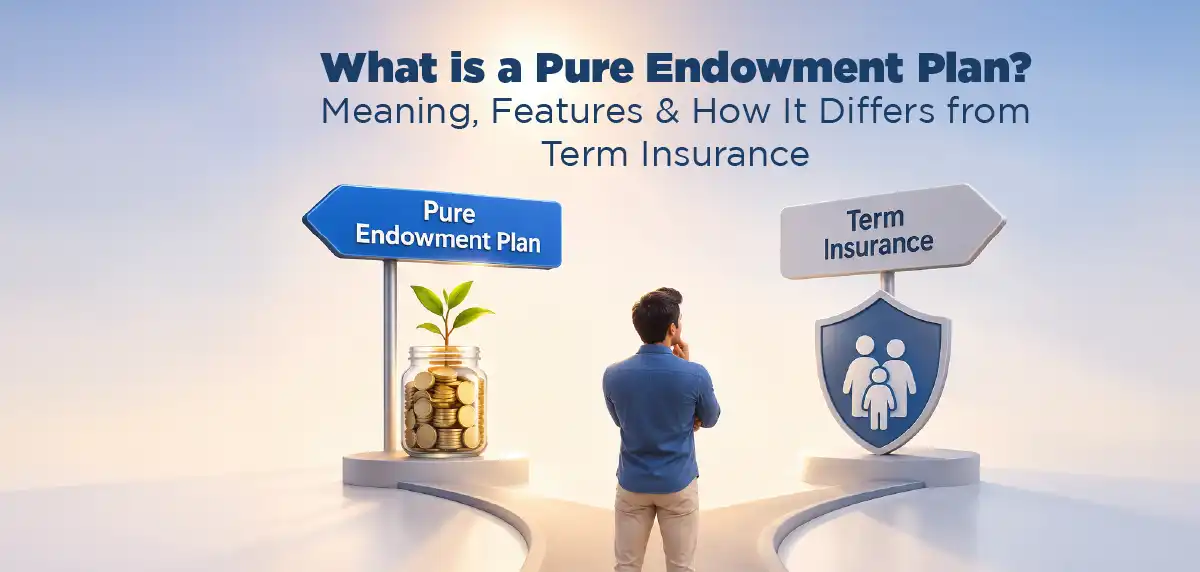
Pure Endowment vs Term Insurance
Basis | Pure endowment | Term cover |
Trigger for payment | Survival to maturity | Death during the covered term |
Primary purpose | Goal-based accumulation | Family financial protection |
Benefit after early death | Usually none in a strict structure | Death benefit, subject to policy terms |
Benefit on survival | Predetermined maturity benefit | Usually none under a basic plan |
Premium pattern | Includes the cost of funding maturity value | Primarily pays for mortality cover |
With term insurance, the insurer pays the applicable sum assured after an eligible death during the policy period. Basic pure term insurance generally pays nothing on survival. This is the mirror image of pure endowment.
A conventional endowment policy normally provides death and maturity benefits. Because it includes savings, its premium for a given cover is generally higher than a comparable term plan. They solve different needs.
If your objective is to combine long-term savings with a life insurance benefit, you can also explore savings-oriented life insurance plans. For example, the IndiaFirst Life Guarantee of Life Dreams Plan is designed around long-term financial goals and policy benefits, subject to the applicable policy terms and conditions.
Who May Consider a Pure Endowment Plan?
You may consider one if you have a defined future goal, prefer a specified maturity amount and already hold adequate protection. It may appeal when predictability matters more than market-linked growth.
It may be unsuitable if your priority is replacing family income after death, you need liquid savings or you seek higher growth potential. Consider inflation because a fixed payout may buy less than expected.
What Should You Check Before Buying?
Confirm the benefit, death provisions, premium term, surrender rules, exclusions and consequences of missed premiums. Compare returns with alternative savings options, but assess protection separately.
Do not assume every product containing “endowment” works identically. Request a benefit illustration and identify guaranteed amounts. Consider prevailing tax law and your circumstances when evaluating proceeds.
Before You Go
A survival benefit can support a future goal, but may not protect your family. Estimate the cover your dependants require before allocating money towards savings.
Calculate Your Ideal Life Cover
Conclusion
The defining question is simple: which event should release the money? A pure endowment policy pays when you reach maturity, while term insurance responds to an eligible death during the policy term. Traditional endowment cover combines both triggers.
Before choosing, map each responsibility to the right tool. Use protection for obligations your family would inherit and savings for money you expect to need while living.