Customers
  Distributor
  Join us as an Advisor
  Employee













































 :
:  :
:  :
: 








Key Takeaways
- Risk retention means handling certain financial risks yourself instead of transferring them through insurance.
- A balanced financial plan retains small risks while transferring major risks through insurance.
- Life insurance helps reduce the financial burden on your family during unexpected events.
When you explore what insurance is, one of the most important concepts you come across is how risk is handled. Insurance exists to transfer financial risk from you to an insurer. However, not all risks are always transferred. This is where risk retention comes into the picture.
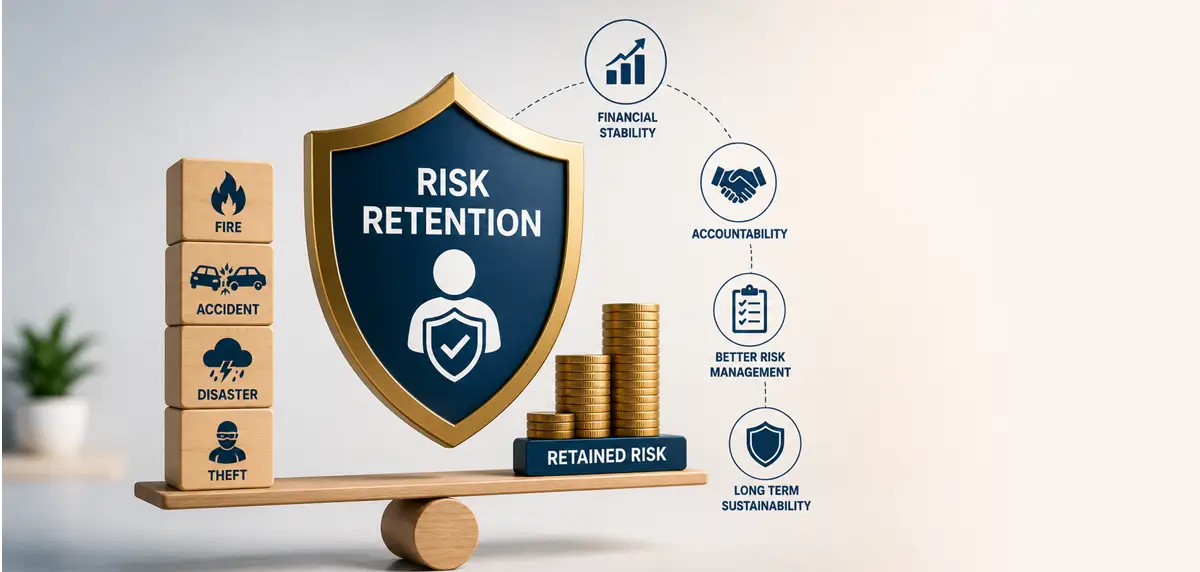
Risk retention simply means that instead of transferring the risk to an insurance company, you choose to bear the financial impact yourself. It is a deliberate decision to handle potential losses without relying fully on insurance cover.
What is Risk Retention
Risk retention is the practice of accepting the financial consequences of a risk instead of transferring it through insurance. In simple terms, you decide to pay for a loss out of your own pocket if it occurs.
Even when you file a claim with your insurance policy, some level of risk retention still exists. Deductibles, co-payments, and exclusions in policies are all forms of partial risk retention.
How Risk Retention Works in Real Life
Risk retention is not always a negative choice. In many cases, you may consciously retain smaller risks while transferring larger ones.
Here is how it typically works:
- You evaluate the potential financial impact of a risk
- If the cost of insuring that risk is too high, you retain it
- If the risk can cause significant financial damage, you transfer it through insurance
For instance:
- You may not insure minor medical expenses and pay them yourself
- But you buy a life insurance cover to protect your family against major financial loss
This balance between retention and transfer is a key part of financial planning.
Types of Risk Retention
Risk retention can take different forms depending on how you manage it.
Active Risk Retention
You knowingly decide to retain a risk after evaluating it
Passive Risk Retention
You retain risk unknowingly, often due to a lack of awareness or planning
Self-Insurance
You set aside funds specifically to cover potential losses instead of buying insurance
Understanding these types helps you make more informed decisions about your financial protection strategy.
Risk Retention vs Risk Transfer
To fully understand risk retention, you need to compare it with risk transfer.
- Risk Retention means you handle the loss yourself
- Risk Transfer means an insurer takes on the financial burden
For example:
- Not buying a life insurance policy is risk retention
- Buying one shifts the financial risk to the insurer
Most individuals use a mix of both approaches. You retain manageable risks and transfer high-impact risks through insurance.
Role of Life Insurance in Managing Risk
A life insurance plan plays a critical role in reducing risk retention where it matters most. It ensures that your dependents are financially protected in case of your death.
Without it, the financial burden stays within the family. With it, the insurer provides a payout that can cover:
- Daily living expenses
- Outstanding loans
- Children’s education
- Long-term financial goals
Using a life insurance calculator, you can estimate the right coverage amount based on your income, liabilities, and future needs. This helps you avoid underinsurance, which is another form of unintended risk retention.
Advantages of Risk Retention
Risk retention is not always a bad strategy. In some cases, it can be beneficial.
- Saves premium costs for low-impact risks
- Gives you more control over your finances
- Avoids unnecessary insurance purchases
If the potential loss is small and manageable, retaining the risk makes practical sense.
Disadvantages of Risk Retention
However, risk retention has clear limitations.
- You bear the full financial burden in case of loss
- It can disrupt long-term financial plans
- Large risks can lead to serious financial instability
For example, not having a life insurance policy can expose your family to significant financial hardship.
When Should You Retain Risk
You should consider risk retention only when:
- The potential loss is small
- You have enough savings to cover it
- The cost of insurance is too high relative to the benefit
For high-impact risks like death, disability, or major illness, relying only on risk retention is not a practical strategy.
Conclusion
Risk retention is a fundamental concept that helps you understand what insurance is at a deeper level. It is not about avoiding insurance altogether but about making smarter decisions on which risks to keep and which to transfer.
In practice, you should retain minor, manageable risks and use a life insurance policy to protect against major financial uncertainties. This balanced approach ensures that your financial plan remains stable even when unexpected events occur.