Customers
  Distributor
  Join us as an Advisor
  Employee













































 :
:  :
:  :
: 


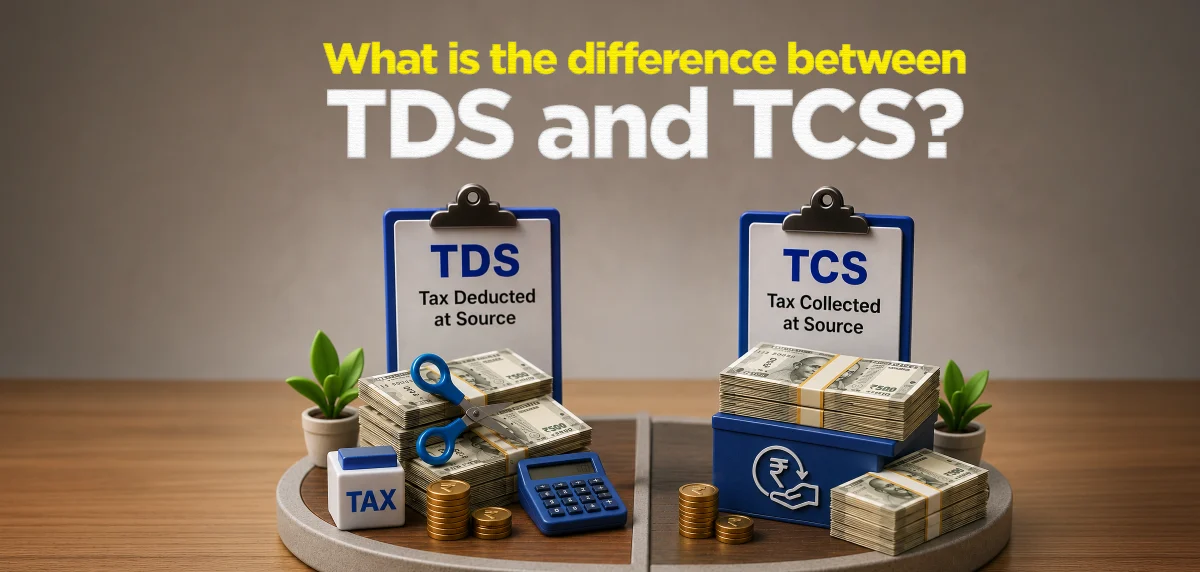




If you look closely at your bank statements, salary slips, or even high-value purchases, you may notice small tax deductions happening quietly in the background. These are not random. They are part of India’s advance tax collection system through TDS and TCS. While both serve the same purpose of collecting tax at the source, they are applicable in completely different situations. Misunderstanding this difference can often lead to confusion during ITR filing and incorrect tax calculations.
Let’s understand the difference between TDS and TCS, how each works, and how they affect your final tax liability.
What TDS Means**
TDS stands for Tax Deducted at Source. It is the tax deducted by the payer at the time of making a payment to you.
This applies to incomes such as
- Salary
- Interest
- Rent
- Professional fees
For example, if your employer pays you ₹50,000 per month, they deduct tax before paying your salary. This deducted amount is deposited with the government on your behalf.
So, in simple terms, TDS is deducted when you earn income.
What TCS Means**
TCS stands for Tax Collected at Source. It is collected by the seller from the buyer at the time of sale of certain goods or services.
This applies to transactions such as
- Sale of scrap
- Foreign travel packages
- Sale of goods above any specified limits
- Purchase of luxury items
For example, if you buy a foreign tour package, the seller collects tax from you at a specified rate and deposits it with the government.
So, TCS is applicable when you spend money on certain transactions.
Difference Between TDS and TCS**
The difference between TDS and TCS becomes clear when you compare how and where they are applicable.
| TDS | TCS |
Who deducts or collects | Payer deducts | Seller collects |
Time of Applicability | At the time of income payment | At the time of sale |
Transactions Applicable | Salary, rent, interest, fees | Sale of goods, foreign remittance, travel |
Impact | Reduces income received | Increases cost paid initially |
Adjustment | Adjusted during ITR filing | Adjusted during ITR filing |
This table captures the core idea behind TDS vs TCS and TCS vs TDS comparisons.
How TDS and TCS Affect Your Tax Liability**
Both TDS and TCS are not final taxes. They are advance tax collections.
When you file your return
- You calculate total income
- Apply slab rates
- Subtract TDS and TCS already paid
If excess tax is deducted or collected, you get a refund. If it is less, you pay the balance.
Using an income tax calculator can help you estimate this before filing.
TDS Rates for FY 2025-2026
Type of Income | TDS Rate |
Salary | As per slab |
Bank interest | 10% |
Rent above threshold | 10% |
Professional fees | 10% |
TCS Rates for FY 2025–26
Transaction | TCS Rate |
LRS remittance for education funded through specified education loan | Nil |
LRS remittance for education or medical treatment above ₹10 lakh | 5% on the amount above ₹10 lakh |
LRS remittance for other purposes above ₹10 lakh | 20% on the amount above ₹10 lakh |
Overseas tour package up to ₹10 lakh | 5% |
Overseas tour package above ₹10 lakh | 5% up to ₹10 lakh and 20% on the excess amount |
Sale of goods above ₹50 lakh under Section 206C(1H) | Not applicable from 01-04-2025 |
Example
You purchase a foreign tour package worth ₹5 lakh.
The seller collects TCS at 5%.
So, the TCS collected is ₹25,000.
If your total income tax liability is ₹20,000, you can adjust this TCS against your final tax payable.
In this case, you can claim a refund of ₹5,000 while filing your ITR.
For a higher-value tour package, the calculation changes. If the tour package is worth ₹12 lakh, TCS is 5% on ₹10 lakh and 20% on the remaining ₹2 lakh. So, the total TCS becomes ₹90,000.
Example
You earn bank interest of ₹60,000 during FY 2025-26.
Since the amount is above the ₹50,000 threshold for non-senior citizens, the bank deducts TDS at 10%.
Therefore, the TDS deducted is ₹6,000.
If your actual tax on this interest income is ₹3,000, you can claim the excess ₹3,000 as a refund while filing your ITR.
The core difference between TDS and TCS lies in timing and responsibility. TDS is applicable when you earn income, while TCS is applicable when you spend on specified transactions. Both are tools used by the government to ensure steady tax collection throughout the year.
Once you understand the TDS vs TCS comparison, you can start seeing them as adjustable components of your overall tax liability. This clarity becomes especially important when reconciling your income, estimating tax using an income tax calculator, and completing accurate ITR filing.
** Tax exemptions are as per applicable tax laws from time to time.