Customers
  Distributor
  Join us as an Advisor
  Employee













































 :
:  :
:  :
: 









Key Takeaways
- An auto sweep automatically moves surplus money from your savings account into a Fixed Deposit (FD) so your idle balance can earn better returns.
- Your money still remains accessible. If your savings balance falls short, then the bank generally transfers funds back automatically.
- This facility can help manage short-term cash more efficiently with zero need for locking money away completely.
- It can work alongside emergency savings, investments, and even your active life insurance policy as part of overall financial planning.
Managing money isn’t always about earning more. Sometimes, it’s simply about using what you already have in a smarter way.
A lot of people leave large balances sitting in their savings accounts because it feels safe and convenient. That’s understandable. You may want quick access for emergencies, bills, travel plans, or upcoming expenses. But here’s the thing, money sitting idle in a regular savings account usually doesn’t grow much over time.
That’s where an auto sweep facility can actually help.
What is an Auto Sweep Account?
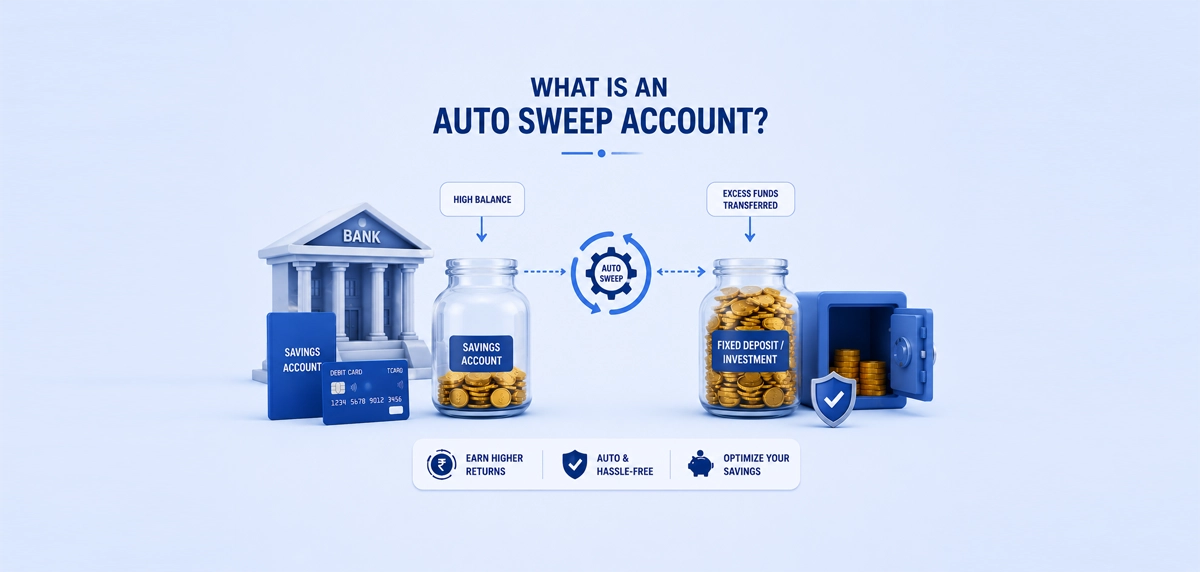
An auto sweep account is a feature linked to your savings account. Once your account balance crosses a certain limit, the extra amount automatically moves into a Fixed Deposit (FD).
Let’s say your bank sets a threshold of ₹50,000.
If your account balance becomes ₹80,000, the extra ₹30,000 gets transferred into a linked FD automatically. You don’t have to manually create deposits every time.
The useful part is flexibility.
Unlike traditional FDs, auto sweep facilities usually allow funds to move back into your savings account automatically whenever needed. So, if your balance falls short while making a payment, the bank may reverse the required amount from the FD portion instantly.
That’s the whole point, honestly. Your money stays accessible while earning better returns in the background.
How Does the Auto Sweep Facility Work?
Once activated, the auto sweep facility runs automatically in most cases. Here’s how it usually works:
A Threshold Balance is Fixed
You or the bank sets a minimum balance that remains untouched in your savings account. It could be ₹25,000, ₹50,000, or any amount depending on the bank’s rules.
Excess Money Gets Swept Automatically
Whenever your account balance crosses that limit, the surplus amount moves into the FD portion automatically.
The Extra Amount Earns Higher Interest
Since the transferred amount sits in a deposit account, it usually earns a better return compared to a standard savings account balance.
Funds Can Move Back if Required
If you make a payment larger than your available savings balance, the bank may transfer funds back automatically from the deposit side.
Benefits of an Auto Sweep Account
The benefits of integrating an auto sweep setup are varied, offering a highly efficient way to manage short-term liquidity while boosting your overall earning potential. Here is a closer look at how an auto sweep facility strengthens your everyday finances:
Maximises Every Idle Rupee
Money sitting unused in a normal savings account often earns limited interest. An auto sweep setup helps surplus funds generate comparatively better returns without requiring constant monitoring.
Frictionless Access During Emergencies
The biggest roadblock with traditional investments is lock-in periods. Financial emergencies don't give you a heads-up. Because the sweep mechanism automatically transfers funds back whenever required, account holders can maintain liquidity without going through lengthy withdrawal procedures.
Helps Smooth Out Cash Flow Volatility
Personal income rarely follows a perfectly flat, predictable line. Some months may bring performance bonuses, freelance windfalls, or tax refunds, while other months bring heavy expenses like insurance premiums, travel costs, or tuition fees. Using an auto sweep in bank accounts effortlessly balances these natural high and low cycles.
Useful During Financial Planning
Good financial planning involves balancing liquidity, investments, protection, and long-term wealth creation. While building emergency savings, individuals may simultaneously invest in mutual funds, purchase a life insurance policy, or explore different types of life insurance for family security.
Keeping idle money optimised through an auto sweep account can complement such financial goals without increasing risk significantly.
Who Should Consider an Auto Sweep Account?
This feature may suit:
- Salaried individuals maintaining emergency funds
- Freelancers with irregular income cycles
- Small business owners handling operational cash reserves
- Disciplined savers pooling money for a massive upcoming expense (like a down payment)
- Investors looking for a temporary, high-yield parking spot for capital before deploying it into the markets.
Someone who is preparing for future responsibilities may already have a term life policy, Systematic Investment Plan (SIP) investments, and retirement contributions in place. An auto sweep account can simply become another practical mode for improving everyday money management.
Things Worth Checking Before Activating It
Before activating the feature, it is important to understand:
- The minimum balance threshold
- The interest structure
- Deposit tenure rules
- Penalties, if any
- The minimum transfer amount
Beyond optimising your savings yield, keeping an eye on your broader financial health is equally essential. True financial awareness means tracking your assets while simultaneously safeguarding your borrowing power.
This is why top-tier savers frequently check CIBIL score parameters to monitor their credit eligibility and track their historical repayment behaviours. Strong savings habits and a healthy credit profile often go hand in hand.
Conclusion
An auto sweep account isn't a replacement for long-term investments but rather a practical bridge that maximises your everyday returns without locking your cash away. It elegantly solves a classic problem: keeping your money productive while keeping it instantly accessible.
When paired with structured investing, emergency planning, and solid insurance protection, this mode turns a basic bank account into a growth driver for your financial routine.