Customers
  Distributor
  Join us as an Advisor
  Employee













































 :
:  :
:  :
: 









Key Takeaways
- Adverse selection is a scenario in which high-risk individuals are more likely to buy insurance than low-risk individuals.
- Insurers manage adverse selection through underwriting, disclosures, and risk-based premium pricing.
- Accurate disclosure helps ensure fair premiums, smooth claims, and effective life insurance coverage.
When you apply for life insurance, the insurer does not just issue a policy based on your request. It evaluates your risk profile, health condition, lifestyle, and financial background before deciding the premium and coverage. This process exists for a reason. Insurance works only when risk is fairly distributed across a large group of people. However, when individuals who are more likely to claim insurance are also the ones most eager to buy it, the balance shifts. This situation is known as adverse selection in insurance.
Understanding adverse selection is essential if you want to make informed decisions about insurance products. It explains why insurers ask detailed questions, why premiums differ across individuals, and why transparency during application is critical.
What is Adverse Selection?
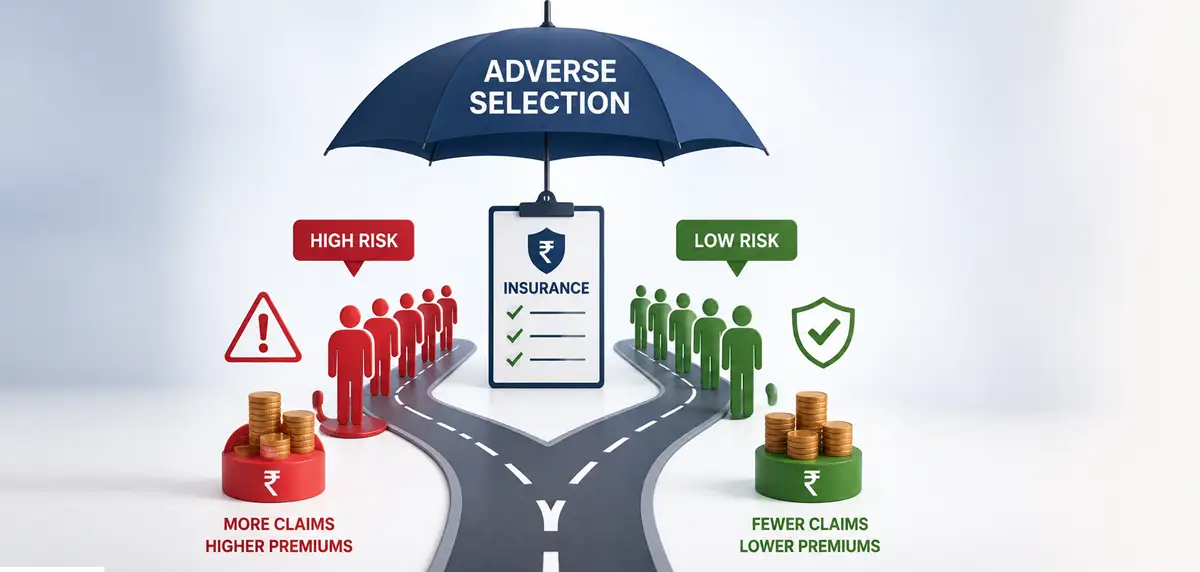
Adverse selection in insurance refers to a scenario where individuals with higher risk are more likely to purchase insurance compared to low-risk individuals. This creates an imbalance in the risk pool.
In a properly functioning insurance system:
- Both low-risk and high-risk individuals participate
- Risk is spread evenly across the pool
- Premiums remain stable and predictable
However, under adverse selection:
- High-risk individuals dominate the pool
- Low-risk individuals may opt out or delay purchase
- The overall risk exposure of the insurer increases
This directly affects how insurance operates in practice. Insurance relies on the principle of risk pooling. When that pool becomes skewed, pricing and sustainability are impacted.
Simple Example of Adverse Selection
Consider two individuals evaluating a life insurance policy:
- Person A: Healthy, no pre-existing conditions
- Person B: Has a known medical condition
If both are offered the same premium:
- Person B is more likely to purchase the policy immediately
- Person A may postpone or avoid buying
Over time, the insurer’s customer base starts consisting of more high-risk individuals. This is a classic case of adverse selection in insurance.
Why Adverse Selection is a Concern for Insurers
Insurance companies depend on accurate risk estimation. Adverse selection disrupts this balance and creates financial pressure.
The impact includes:
- Higher-than-expected claim payouts
- Reduced profitability
- Need for premium increases
- Stricter underwriting policies
If this continues unchecked, it can lead to a cycle where rising premiums push low-risk individuals out of the system, worsening the risk pool further.
That is why insurers actively manage adverse selection in insurance through structured underwriting and pricing mechanisms.
How Insurers Manage Adverse Selection
To maintain a balanced risk pool, insurers adopt multiple control measures.
Medical underwriting
Insurers assess your health condition through medical tests and history
Detailed disclosures
Applicants must provide accurate information about lifestyle, habits, and existing conditions
Risk-based pricing
Premiums are adjusted based on individual risk levels
Waiting periods
Certain benefits are delayed to prevent immediate claims
Policy exclusions
Specific risks may be excluded, especially in the initial years
These measures ensure that life insurance products remain sustainable and fairly priced.
Importance of Accurate Disclosure
Disclosure plays a central role in managing adverse selection in insurance.
When you apply for life insurance, you are expected to provide complete and accurate information. This includes:
- Medical history
- Smoking or drinking habits
- Existing illnesses
- Previous insurance policies
Accurate disclosure ensures:
- Correct premium calculation
- Smooth claim settlement
- Reduced risk of policy disputes
Misrepresentation increases the risk of adverse selection and can lead to claim rejection. This directly affects the importance of life insurance, as the policy may fail when it is needed the most.
Impact on Premiums
One of the most visible effects of adverse selection is on insurance pricing.
When insurers face higher risk levels:
- Premiums are increased across the board
- Low-risk individuals may find policies expensive
- Participation from healthier individuals reduces
This creates a negative cycle:
- A higher-risk pool means higher premiums, which means lower participation from low-risk individuals
Breaking this cycle requires careful underwriting and balanced participation.
Adverse Selection vs Moral Hazard
Although often confused, adverse selection and moral hazard are different concepts.
Factor | Adverse Selection | Moral Hazard |
Timing | Before buying insurance | After buying insurance |
Cause | Hidden risk information | Change in behaviour after coverage |
Example | High-risk individual buying more insurance | Careless behaviour due to coverage |
Understanding this distinction helps clarify how insurance works beyond just coverage and premiums.
Role of Life Insurance in Financial Planning
Despite challenges like adverse selection in insurance, the role of life insurance remains critical in your financial strategy.
The importance of life insurance includes:
- Providing financial protection to your family
- Covering outstanding liabilities
- Supporting long-term goals such as education and retirement
- Ensuring income replacement in case of unexpected events
These benefits make insurance a foundational part of financial planning, regardless of risk dynamics.
Choosing the Right Policy
When evaluating the best life insurance plans in India, you should focus on suitability rather than just cost.
Key factors to consider:
- Adequate coverage based on income and expenses
- Claim settlement ratio of the insurer
- Policy terms and exclusions
- Premium affordability over the long term
A well-chosen policy ensures that your coverage remains effective without unnecessary financial strain.
Using a Life Insurance Calculator
A life insurance calculator helps you estimate the right coverage amount based on your financial profile.
It considers:
- Current income
- Future financial goals
- Outstanding liabilities
- Inflation
Using a life insurance calculator allows you to make structured decisions instead of relying on assumptions. It also helps avoid underinsurance, which is a common issue.
Why Adverse Selection Matters to You
While adverse selection in insurance is often seen as an insurer’s concern, it has direct implications for you as a policyholder.
It influences:
- Premium levels
- Policy conditions
- Underwriting requirements
- Approval timelines
A system affected by adverse selection becomes stricter and more expensive for everyone. Responsible participation and accurate disclosure help maintain balance.
Conclusion
Adverse selection in insurance is a fundamental concept that shapes how insurance products are designed, priced, and distributed. It highlights the risks that arise when high-risk individuals dominate the insurance pool. For insurers, it requires careful management through underwriting and pricing strategies. For you, it explains why transparency, accurate disclosures, and proper planning are essential. When you understand adverse selection, choose appropriate life insurance, and use tools like a life insurance calculator, you create a more reliable and effective financial safety net.