Customers
  Distributor
  Join us as an Advisor
  Employee













































 :
:  :
:  :
: 








Key Takeaways
- Selecting the correct ITR form, assessment year, and personal details is essential to avoid defective returns, delayed refunds, and unnecessary notices from the Income Tax Department.
- Always reconcile your income, TDS, and investments with Form 26AS, AIS, and TIS before filing to minimise errors and ensure accurate tax reporting.
- Report all sources of income, including interest, capital gains, rental income, and foreign assets, wherever applicable, to avoid under-reporting and penalties.
- Claim all eligible deductions, verify your return on time, and respond promptly to tax notices to ensure a smooth and hassle-free ITR filing experience.
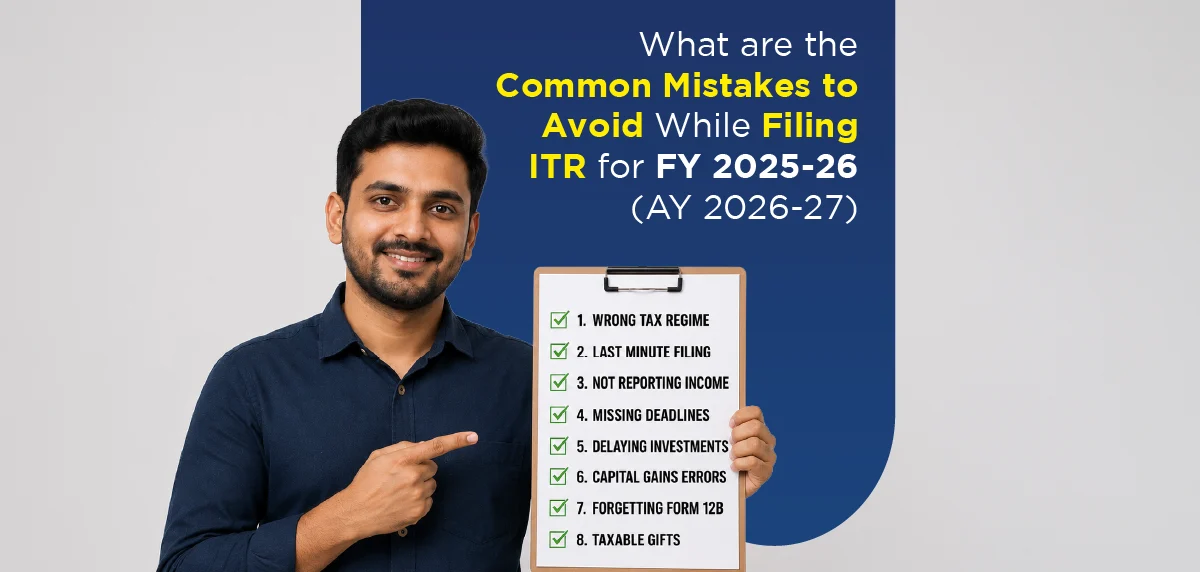
Filing your Income Tax Return (ITR) is one of the most important annual financial responsibilities. While the process has become more streamlined with online filing and pre-filled data, many taxpayers still make errors that can result in delayed refunds, tax notices, penalties, or additional tax liabilities.
For FY 2025-26 (AY 2026-27), taxpayers should be especially careful about verifying their income, deductions, and tax credits before submission. Even a small mistake can lead to an incorrect income tax return filed situation that may require filing a revised return later.
To help you avoid unnecessary complications, here are some of the most common mistakes while filing ITR and practical tips to ensure a smooth filing experience.
Why Accuracy Matters When Filing ITR
Your ITR serves as an official declaration of your income, taxes paid, deductions claimed, and investments made during the financial year. Any discrepancy between your return and the information available with the Income Tax Department can trigger scrutiny or delay processing.
Many cases of income tax wrong filing occur simply because taxpayers rush through the process close to the due date. Careful review and timely filing can help avoid these issues.
1. Choosing the Wrong ITR Form
One of the most common mistakes is selecting an incorrect return form.
Different taxpayers are required to use different types of ITR forms depending on their income sources and eligibility.
For example:
ITR Form | Suitable For |
ITR-1 | Salaried individuals with income up to prescribed limits and simple income sources |
ITR-2 | Individuals with capital gains or multiple properties |
ITR-3 | Individuals having business or professional income |
ITR-4 | Eligible taxpayers under presumptive taxation |
Selecting the wrong form can result in defective return notices and delays in processing.
2. Mentioning the Wrong Assessment Year
Many taxpayers accidentally select the incorrect assessment year while filing.
For income earned during FY 2025-26, the corresponding assessment year is AY 2026-27.
A mismatch can create confusion in tax records and may even result in duplicate tax demands. Before submitting your return, always verify the selected assessment year.
3. Providing Incorrect Personal Information
Personal details should exactly match the information available in your PAN records.
Common errors include:
- Incorrect PAN number
- Wrong date of birth
- Outdated address
- Incorrect mobile number
- Wrong email ID
Similarly, taxpayers expecting refunds should carefully verify bank account details, including account number and IFSC code. Incorrect details can delay refund processing.
4. Not Reporting All Sources of Income
A major reason for filing wrong income tax return is failure to disclose income from all sources.
Apart from salary, you must also report:
- Savings account interest
- Fixed deposit interest
- Rental income
- Dividend income
- Capital gains
- Freelance income
- Income from other sources
Even exempt income must be disclosed wherever applicable.
For instance, certain long-term capital gains may qualify for tax exemptions up to specified limits, but they still need to be reported in the relevant schedules.
5. Ignoring Form 26AS, AIS and TIS
Before you file ITR, it is important to reconcile your income and taxes with official records.
Three important documents should always be reviewed:
Form 26AS
Shows:
- TDS deducted
- Advance tax paid
- Self-assessment tax
- TCS details
AIS (Annual Information Statement)
Contains:
- Securities transactions
- Interest income
- Foreign remittances
- GST-related information
TIS (Taxpayer Information Summary)
Provides consolidated taxpayer information and derived values.
Failure to reconcile these documents can result in mismatches and tax notices.
6. Not Consolidating Income from Multiple Employers
Changing jobs during the financial year can complicate tax filing.
Many salaried employees receive multiple Form 16s and mistakenly report only one source of salary income.
You must aggregate salary income from all employers and include the total amount while filing your return.
Failing to do so can lead to under-reporting of income and potential notices from the department.
7. Missing Out on Eligible Deductions
Many taxpayers pay more tax than necessary because they forget to claim eligible deductions.
Popular deductions include:
- Section 80C investments
- Life insurance premiums
- Employee Provident Fund contributions
- Public Provident Fund contributions
- ELSS investments
- Home loan principal repayment
- Tuition fees
Understanding available deductions can significantly reduce your taxable income.
You can also use an income tax calculator to estimate your tax liability after considering eligible deductions.
8. Incorrect HRA Claims
House Rent Allowance (HRA) claims often contain errors.
Common mistakes include:
- Not maintaining rent receipts
- Incorrect landlord details
- Missing landlord PAN where applicable
- Claiming HRA despite living in self-owned accommodation
Taxpayers who fail to submit HRA proofs to employers may still claim eligible exemption while filing their returns, provided all supporting documents are available.
9. Not Paying Advance Tax
Advance tax applies when total tax liability exceeds the prescribed threshold after accounting for TDS.
Advance tax is generally payable in instalments throughout the financial year.
Failure to pay advance tax on time may attract interest under applicable provisions of the Income Tax Act.
Many taxpayers only discover this liability while filing returns and end up paying additional interest.
10. Misreporting Interest Income
Interest earned on various investments is often overlooked.
Income from the following sources must generally be reported:
- Savings accounts
- Fixed deposits
- Recurring deposits
- National Savings Certificates (NSC)
One common misconception is that NSC interest is entirely tax-free. While certain benefits may be available under specific provisions, the interest itself remains taxable and should be disclosed appropriately.
11. Not Verifying the Applicable Tax Regime
With taxpayers now having a choice between the old and new tax regimes in many cases, selecting the appropriate option is important.
Before filing, compare:
- Available deductions
- Exemptions
- Applicable income tax slab
- Total tax liability under each regime
Choosing the wrong regime may result in higher tax outgo than necessary.
12. Failure to E-Verify the Return
Many taxpayers assume their filing process is complete after submitting the return.
However, filing is incomplete unless the return is verified.
ITR can be verified through:
- Aadhaar OTP
- Net banking
- Demat account
- Bank account EVC
Failure to complete verification within the prescribed timeline may render the return invalid.
13. Ignoring Tax Notices
Sometimes taxpayers receive notices regarding:
- Mismatch in income
- Incorrect deductions
- Unreported transactions
- Outstanding tax demands
Ignoring these communications can lead to penalties and further scrutiny.
Always review notices carefully and respond within the specified deadline.
14. Not Reporting High-Value Assets
Individuals and HUFs with income exceeding prescribed thresholds may need to disclose asset details under Schedule AL.
This includes information relating to:
- Immovable property
- Jewellery
- Vehicles
- Financial assets
- Liabilities
Failure to furnish these disclosures can invite questions from tax authorities.
15. Not Disclosing Foreign Assets and Income
Resident and ordinarily resident individuals must disclose foreign assets and foreign income, even if such income is not taxable in India due to treaty provisions.
These disclosures may include:
- Foreign bank accounts
- Foreign shares
- Overseas mutual funds
- Employee stock options
- Foreign property holdings
Failure to report such information can attract severe penalties under applicable laws.
What to Do If You Have Filed the Wrong ITR?
If you discover that a wrong ITR filed contains mistakes, do not panic.
The Income Tax Act allows taxpayers to file a revised return within the prescribed timelines.
Common reasons for revision include:
- Missing income disclosures
- Incorrect deduction claims
- Wrong bank details
- Incorrect tax calculations
- Data entry mistakes
Prompt correction can help avoid future complications arising from an incorrect income tax return filed.
Avoid the Mistake of Not Claiming Your Full 80C Deduction
While taxpayers focus on avoiding errors, many also miss valuable tax-saving opportunities.
One of the most commonly underutilised deductions is Section 80C in the old tax regime. Life insurance premiums, provident fund contributions, ELSS investments, tuition fees, and principal repayment on home loans can help reduce taxable income significantly.
Before filing your return, review all eligible investments and expenses carefully. Avoid the mistake of not claiming your full 80C deduction and ensure that life insurance premiums and other qualifying investments are properly reported to maximise your tax savings.
Conclusion
Filing your ITR accurately is just as important as filing it on time. Most common mistakes while filing ITR occur due to incomplete information, lack of reconciliation with official records, or overlooking eligible deductions. By reviewing your income sources, verifying Form 26AS, AIS and TIS, selecting the correct return form, and claiming all eligible benefits, you can minimise the risk of income tax wrong filing and ensure a hassle-free tax filing experience for FY 2025-26 (AY 2026-27).
The information provided on this site is for general informational and educational purposes only. It does not constitute, and should not be relied upon as, tax or financial advice. Tax laws and regulations are complex and change frequently. We highly recommend consulting with a licensed tax professional regarding your specific financial situation before making any decisions.