Customers
  Distributor
  Join us as an Advisor
  Employee













































 :
:  :
:  :
: 






Key Takeaways
- GST in India is divided into CGST, SGST, IGST, and UTGST to ensure tax distribution between the central and state governments based on transaction type.
- In intra-state transactions, GST is split into CGST and SGST, while inter-state transactions are taxed entirely under IGST.
- UTGST applies in Union Territories and replaces SGST for local transactions within those regions.
- The applicability of GST types depends on where the transaction occurs.
- Understanding different GST types helps ensure accurate tax calculation, compliance, and better interpretation of invoices and costs.
The introduction of GST in India brought multiple indirect taxes under a single structure. Instead of separate taxes at different stages, GST created a system where tax is applied based on the nature of the transaction. To make this work across states and within states, GST is divided into different components.
Understanding the types of GST in India is important because each type applies to a specific kind of transaction. The classification ensures that tax collection is shared appropriately between the central and state governments. It also helps businesses apply the correct tax depending on whether a transaction is intra-state or inter-state.
What is GST, and Why is it Divided?
GST, or Goods and Services Tax, is a unified tax system applied to the supply of goods and services. It replaces multiple indirect taxes and creates a standardised structure for taxation across the country.
However, since India follows a federal system, both the central and state governments have the authority to collect taxes. This is why GST is divided into different components. These types of GST in India ensure that tax revenue is distributed between both levels of government based on the nature of the transaction.
Taxes Replaced by GST in India
Before GST was introduced, multiple indirect taxes were charged separately by the central and state governments. This created overlapping taxation and made compliance more complicated for businesses. GST replaced many of these taxes with a unified structure to simplify taxation and improve transparency.
The following taxes were replaced under the GST system:
Central Taxes Replaced by GST | State Taxes Replaced by GST |
Central Excise Duty | Value Added Tax (VAT) |
Service Tax | Entry Tax |
Additional Customs Duty | Luxury Tax |
Special Additional Duty of Customs | Entertainment Tax |
Central Sales Tax | Purchase Tax |
Excise Duty on Medicinal and Toilet Preparations | Taxes on lotteries, betting, and gambling |
This transition helped create a more standardised taxation system across India while reducing the cascading effect of taxes.
Different Types of GST in India
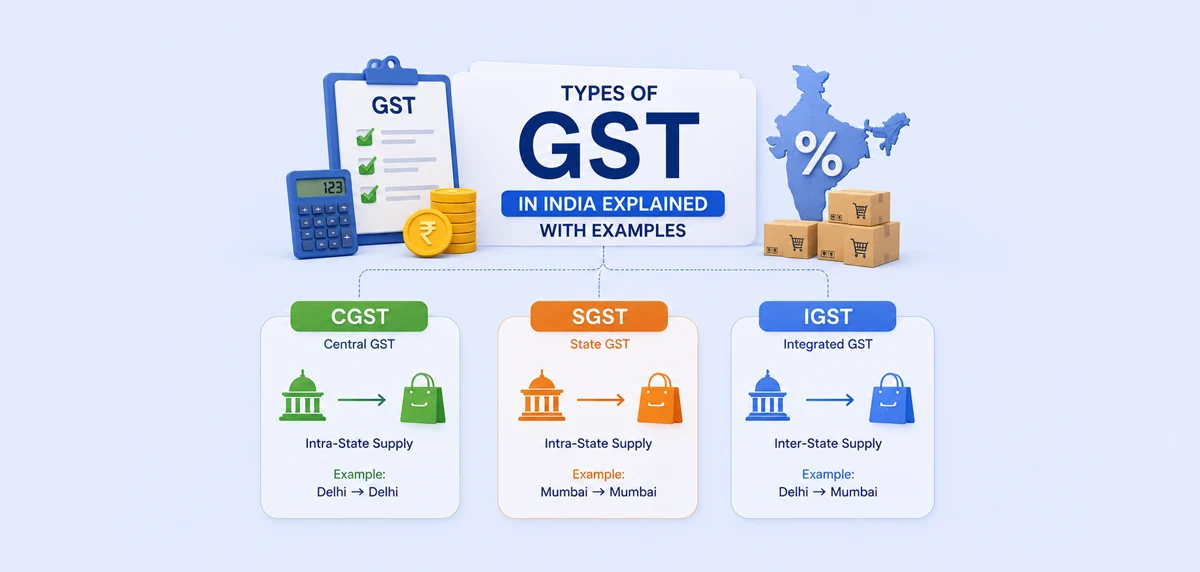
There are four main types of GST in India, each applicable in specific situations. These are CGST, SGST, IGST, and UTGST. Together, they form the GST structure used across the country.
When people refer to the different types of GST in India, they are usually referring to these four categories. Each of them is applied based on whether the transaction takes place within a state or between states.
Central Goods and Services Tax (CGST)
CGST is one of the primary types of GST in India and is collected by the central government. It is applied when a transaction takes place within the same state.
In an intra-state transaction, the tax is divided between CGST and SGST. For example, if goods or services are sold within a state, a portion of the tax is collected as CGST by the central government.
This ensures that the central government receives its share of tax revenue from transactions occurring within states.
State Goods and Services Tax (SGST)
SGST is collected by the state government and is also applied in intra-state transactions. It works alongside CGST, meaning both are applied together when the transaction occurs within the same state.
For example, if a service is provided within a state, SGST is collected by that state government, while CGST is collected by the central government. This division ensures that both levels of government share tax revenue fairly.
SGST is an essential part of the GST structure, especially for local transactions.
Integrated Goods and Services Tax (IGST)
IGST is applied when goods or services are supplied between two different states. It is collected by the central government and later distributed between the respective states.
In inter-state transactions, instead of applying both CGST and SGST, IGST is charged. This simplifies tax collection for transactions that cross state boundaries.
IGST also applies to imports and exports, making it an important component among the types of GST in India.
Union Territory Goods and Services Tax (UTGST)
UTGST is applicable in Union Territories that do not have a legislative assembly. It functions similarly to SGST but is collected by the Union Territory administration.
When a transaction takes place within a Union Territory, UTGST is applied along with CGST. This ensures that tax revenue is appropriately allocated even in regions that are not states.
GST Applicability Matrix
Transaction Type | CGST | SGST | IGST | UTGST |
Intra-state (within the same state) | Yes | Yes | No | No |
Inter-state (between states) | No | No | Yes | No |
Union Territory transaction | Yes | No | No | Yes |
GST Compensation Cess
GST Compensation Cess is applied on specific goods to compensate states for any revenue loss resulting from the implementation of GST. It is not applied universally and is limited to certain categories such as luxury goods or products considered demerit in nature.
Unlike CGST, SGST, IGST, and UTGST, this cess is not based on the location of the transaction. Instead, it is charged in addition to GST where applicable. Its primary purpose is to support states during the transition to the GST system rather than function as a standard component of taxation.
How GST Types Apply in Real Transactions
The application of different types of GST in India depends on the nature of the transaction. If goods or services are supplied within a state, CGST and SGST are applied together.
If the transaction is between states, IGST is applied instead. In Union Territories, UTGST replaces SGST for intra-territory transactions.
This structure ensures that the tax system remains consistent while also accommodating different administrative regions[AR3] .
Application of Different Types of GST
The application of GST depends on whether a transaction takes place within a state, between states, or within a Union Territory. Each type of GST is applied differently based on the nature and location of the transaction.
Type of GST | Applicability | Collected By | Example |
CGST | Intra-state transactions | Central Government | Sale within Maharashtra |
SGST | Intra-state transactions | State Government | Service provided within Karnataka |
IGST | Inter-state transactions | Central Government | Sale from Gujarat to Delhi |
UTGST | Transactions within Union Territories | Union Territory Administration | Service within Chandigarh |
This structure ensures that tax revenue is distributed correctly while maintaining consistency across different regions.
GST Example
The working of GST becomes easier to understand through practical examples.
Intra-state Transaction Example
Suppose a product worth ₹1,000 is sold within the same state and the applicable GST rate is 18%.
In this case:
- CGST = 9% = ₹90
- SGST = 9% = ₹90
Total GST charged = ₹180
Final price = ₹1,180
Both the central and state governments receive an equal share of the tax.
Inter-state Transaction Example
Suppose the same product worth ₹1,000 is sold from one state to another with an 18% GST rate.
In this case:
- IGST = 18% = ₹180
Total GST charged = ₹180
Final price = ₹1,180
The entire tax is collected as IGST by the central government and later distributed as applicable.
GST in Life Insurance
GST is also applicable to services such as insurance. When it comes to GST in life insurance, tax is applied on the premium paid for a life insurance policy.
The applicable GST depends on the nature of the transaction, similar to other services. For example, if the policy is issued within a state, CGST and SGST are applied. If it involves inter-state elements, IGST may apply.
Understanding how GST applies to a life insurance policy helps in knowing the overall cost involved in purchasing and maintaining the policy.
Why Understanding GST Types is Important
Knowing the types of GST in India helps individuals and businesses apply the correct tax in different situations. It reduces errors in compliance and ensures that tax payments are made accurately.
It also helps in understanding how taxes are distributed between governments. This is important for businesses that operate across multiple states or deal with inter-state transactions.
Clarity on the different types of GST in India also makes it easier to interpret invoices and tax-related documents.
Conclusion
The GST system in India is structured to accommodate both central and state taxation through different components. CGST, SGST, IGST, and UTGST form the core of this structure, with additional elements like compensation cess playing a supporting role.
Understanding the GST types in India is not just about definitions. It helps in applying tax correctly, managing compliance, and understanding how transactions are taxed across regions.
Over time, familiarity with these types of GST in India makes it easier to navigate the tax system with more clarity and confidence.