Customers
  Distributor
  Join us as an Advisor
  Employee













































 :
:  :
:  :
: 









Key Takeaways
- An annuity table helps estimate the present or future value of regular payments.
- The factor changes with the interest rate, payment period and, for life annuities, longevity assumptions.
- It is a planning tool, not a guarantee of the pension amount an insurer will offer.
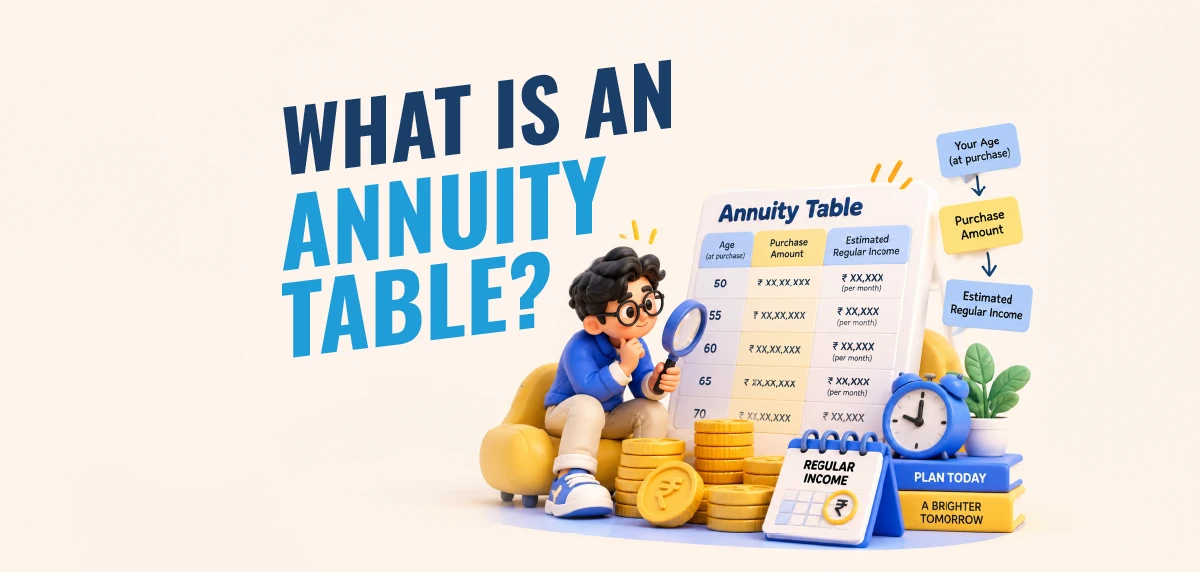
If you are building a retirement corpus, you may want to know how much regular income a particular amount of money can support. That is where an annuity table becomes useful. It translates a stream of future payments into a single value today, or helps you work backwards from your desired income to estimate the corpus you may need.
In practical annuity planning, a table helps connect three important figures: the money available today, the income you want and the period for which you expect that income to continue. It is commonly used in financial calculations, pension estimates and insurance pricing. However, the amount quoted for a life annuity will depend on the insurer’s product terms and prevailing annuity rates, not on one generic table alone.

What is an Annuity?
The annuity meaning is simple. An annuity is a series of payments made at regular intervals. You may receive ₹25,000 each month after retirement, for example, or pay a fixed amount every year towards a savings goal.
There are different types of annuities. An immediate annuity generally starts paying income soon after you invest a lump sum. A deferred annuity is designed for income that begins at a later date. Payments may continue for a fixed term, for your lifetime or for the lifetime of you and your spouse, depending on the option selected.
An annuity table does not itself create income. It provides factors that help estimate the value of those future payments. This makes it useful when you are comparing retirement-income choices or conducting annuity planning.
How Does an Annuity Table Work?
An annuity factor table lists numerical factors based on an assumed interest rate and a specified number of payment periods. You use the relevant factor to calculate either the present value of future payments or the future value of regular contributions.
For instance, assume you want ₹1 lakh annually for 15 years after retirement. A present-value annuity formula table can indicate how much money you may need today to fund those payments at an assumed rate of return. The exact factor will vary when the interest-rate assumption or payment frequency changes.
If payments are made at the end of each period, the calculation is generally called an ordinary annuity. If they are made at the beginning, it is called an annuity due. An annuity table may provide separate factors for both because the timing of each payment affects its value.
What is an Annuity Factor Table?
An annuity factor table is a reference table containing factors for different interest rates and time periods. You first choose the assumed rate and the number of years or months, then locate the matching factor.
A present-value annuity factor table answers this question: “What is a series of future payments worth today?” A future-value annuity factor table answers another question: “What could my regular investments grow into over time?”
For example, if a factor from an annuity value table is 10.8, ₹1,00,000 of annual income would have an estimated present value of ₹10.8 lakh under that table’s assumptions. This is only an illustration. Taxes, charges, payment timing and changes in returns can affect real-world outcomes.
What is an Annuity Formula Table?
An annuity formula table saves you from calculating the formula manually every time. The standard present-value formula for an ordinary annuity is:
Present Value = Regular Payment × Annuity Factor
The table supplies the factor. You only need to multiply it by the payment amount you want. A future-value annuity formula table works in a similar way, but it estimates what a series of regular investments may accumulate to.
While a table makes calculations quicker, it is important to use realistic assumptions. Choosing an unusually high return can make your required corpus appear smaller than it may actually be. This is why your annuity planning should consider inflation, healthcare costs, other income sources and the possibility of living longer than expected.
How do Annuity Rates Affect Your Income?
Annuity rates are the rates used by insurers to determine the income payable for a given purchase price. They can vary based on your age, chosen payout option, payment frequency, whether you include a spouse and whether you select a return-of-purchase-price feature.
For life-based products, insurers also consider mortality assumptions. A life annuity may continue for an uncertain period, so its calculation differs from a fixed-term payment schedule in a basic annuity table. As a result, an annuity calculator can give you an estimate, but the final income offered under an annuity product may differ. If you want a sense of what a guaranteed annuity income could look like for your own profile, a plan like the IndiaFirst Life Guaranteed Annuity Pension Plan is built around this exact payout structure and can be a useful reference point.
You should compare annuity rates across options carefully. A higher immediate income may come with fewer survivor benefits, while an option that continues income to your spouse may provide a lower initial payout.
How Can You Use an Annuity Calculator?
An annuity calculator can make the process more convenient than checking a printed annuity table. You can enter your target income, expected return, time horizon and contribution amount to see illustrative results.
Use an annuity calculator to test different scenarios. For example, you can compare retiring at 60 and 65, increasing your monthly savings or choosing a lower return assumption. These comparisons can show whether your current savings pattern is likely to support your retirement objective.
However, do not treat the result as a guaranteed outcome. An annuity calculator uses the information and assumptions you provide. Review the product’s benefit illustration and policy terms before you make a purchase decision.
Before You Go
Retirement can feel distant until regular income becomes your main source of financial security. Use a retirement planning calculator to estimate the corpus you may need for the lifestyle you want.
Calculate Now
Conclusion
So, what is an annuity table? It is a practical reference that helps you value regular payments and plan the corpus needed to support them. Whether you use an annuity table, an annuity value table or an annuity calculator, the quality of your estimate depends on realistic assumptions. Review annuity rates, account for inflation and build your retirement plan around the income you may actually need, not only the corpus you hope to accumulate.